CMC Seminar – Winter/Spring 2011

The next China Media Centre seminar will take place on Wednesday, 2 February between 2-4pm in room E4.4 at the Harrow campus. Norwegian academic Elin Sather will be talking about her latest project, Critical journalism in China: Journalists, social activists and order uk online viagra tablets new spaces of representation. The seminar will comprise an introductory lecture, followed by an open discussion.

***

Critical journalists and social activists are contributing to public debate in China, through their investigations, commentaries and through voicing grievances and concerns that would otherwise be ignored. These provide people with new channels of representation. At the same time both critical journalists and activists remain subject to party-state surveillance, and both freedom and control appear to be increasing. The seminar will explore this puzzle: what does it mean that more issues are being discussed by increasing numbers of critical journalists and activists while party-state control remains strict?

***

Elin is a post-doctoral fellow working within the Department of Sociology and Human Geography at the University of Oslo. Further information on her project can be found at: http://www.sv.uio.no/iss/english/research/projects/critical-journalism-in-china/index.html

Related Images:

CMC Seminar – Autumn/Winter, 2010

The next CMC seminar will take place between 2pm and 4pm on December 1st, 2010 in room E4.4 at the Harrow campus. Chang Yiru, former documentary maker with CCTV-9, will be talking about her film, Half the Sky: Chinese Women Over The Past 60 Years, and will available to answer questions about both the documentary’s subject and buy generic viagra online fast shipping themes, and the process behind the film’s production. All are welcome. 

Related Images:

Recent and Forthcoming Courses at China Media Centre

RECENT AND FORTHCOMING COURSES AT CMC

China Media Centre has designed a suite of courses which are especially, though not exclusively, designed for Chinese applicants.

This year we have held two separate sessions of our course ‘INNOVATION AND CREATIVITY IN THE UK MEDIA’ and two of ‘CITY BRANDING AND INTERNATIONAL COMMUNICATIONS’. They are aimed at mid-career professionals in, respectively, the broadcast industry and the public spokesperson track within regional and city government administrations.
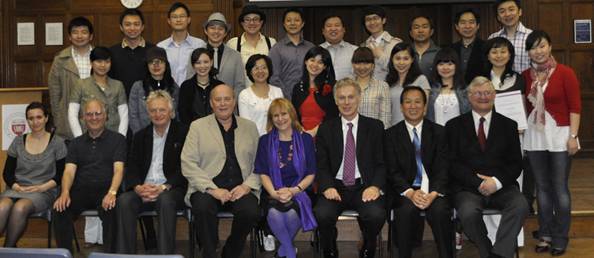
 clip_image003Certificate ceremony March 2010; CMC INNOVATION2 coursE

 Each course includes a few days out with London; in Scotland, a programme introducing the visitors to Scottish public affairs has been hosted several times by John Brown, the PR expert who is brother to the recent Prime Minister. One of the courses for government officials visited Northern Ireland and the next one will be briefed in Cardiff on Welsh devolution.
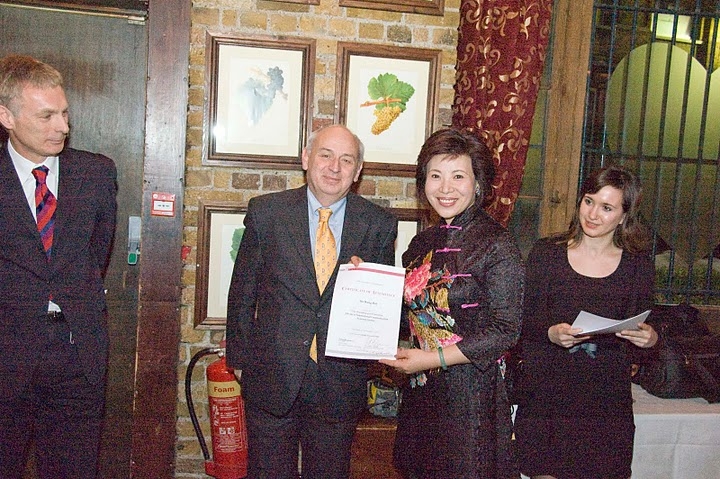
BCG_77Certificate ceremony March 2010; CMC CITY1 course; Ms WANG Hui, Director of Information Office of Beijing Municipality, receiving the certificate from Geoffrey Davies, Head of the Department for Journalism and Mass Communications, and Prof Hugo de Burgh, Director of China Media Centre.

 We are also recruiting to 3 summer schools for Chinese media undergraduates in July and August; applications received so far come from students at universities as diverse as Shandong University (where the Director is an Honorary Professor), Renmin University, Communications University, Guangzhou University of Foreign Studies and cialis kopen in zweden Shenzhen University.

Also planned for this year is a course ‘THE ORGANISATION AND SKILLS OF UK PUBLIC COMMUNICATION ‘, aimed at national level media specialists, and indications so far are that it will be attended by high ranking civil servants and the heads of public affairs of some of China’s largest state-owned corporations.

ACADEMIC CONFERENCE

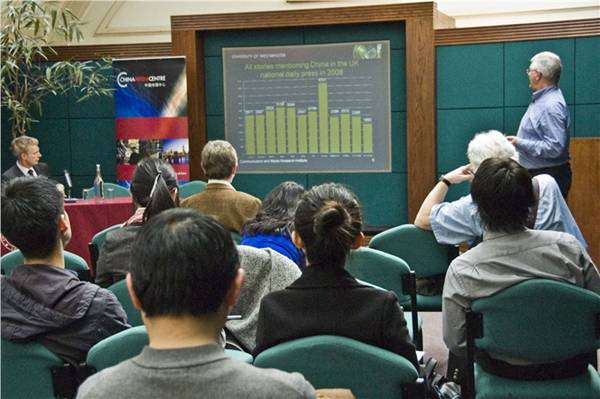
In April 2010, CMC also held its annual academic conference at Regent Campus, this year titled CHINA’S SOFT POWER. Delegates attending from all continents engaged keenly with the topics under discussion.
 clip_image002

 The dramatic economic growth in China has meant a renewed international influence. President Obama’s recent visit, and the effective establishment of the “G2,” marked international recognition of the fact that China is, today, a central actor in the world economy. Historically, economic power has always been accompanied by increasing international cultural influence – soccer, Hollywood and karaoke are just some of the things bequeathed by other big economies to the rest of the world. It is certain that China’s economic stature will also be reflected in the diffusion of Chinese culture.

This reality is already recognised by many in China and outside. The Chinese government has a “going out” strategy, aiming to make the Chinese language, Chinese culture, and the Chinese media more visible internationally. At the same time, broadcasters who were once content to buy programmes and copy western models are today planning to enter the international market place as sellers of their own products.


TEACHING THE MEDIA-a course at Chongqing’s XINAN UNIVERSITY OF POLICY & LAW

Geoffrey Davies, Head of Department of JMC, will lead a delegation of 4 lecturers to address media teachers from all over SW China in workshops to be held in early July. Prof Jeanette Steemers is a world expert on children’s’ television, David Dunkley Gyimah a specialist on New Media and Anthony McNicholas, who runs the BBC-History discussion list and is a specialist on Media and Communications.

LECTURE

The Director gave the opening address at a conference at Wolfson College Oxford on 10-11 June, AFRICA, CHINA AND THE WEST MEET: TOWARDS NEW FRAMEWORKS FOR MEDIA DEVELOPMENT. Among the very scholars from many countries giving papers were UW colleagues Dr Xin Xin and Dr Winston Mano.

Prof Hugo de Burgh will give a keynote speech at the 11th All-China Communications Conference, to be held at Peking University 9-12 July.

Related Images:

Ideas and Values Move between China and Western Societies:A seminar given by Prof. Greg Philo (24 March 2010)

China Media Centre

2010 Spring Seminar Series

How Ideas and Values Move between China and Western Societies

Speaker: Prof. Greg Philo

University of Glasgow, Research Director of home Glasgow Media Group

Date: Wednesday 24th March, 2010
Time: 2.00-4.00 pm
Venue: Lecture Theater 2  Harrow Campus

This lecture focuses on cross cultural perceptions and the processes by which ideas and values move between societies. It is based on research using focus groups, responses to questionnaires and interviews with 140 Chinese students, cultural workers and teachers. It will show how the experience of living in the UK can both alter prior expectations of the country as well as generating processes of critical reflection about the nature of both China and western societies. The participants focused on the evaluation of educational systems, the understanding of rights, law and social obligations and how these affected the current status of women. Social change does not result simply from exposure to new ideas, but cross-cultural contacts and experience can be factors in the movement away from traditional structures in that they highlight alternative ways of understanding the self in relation to others and new possibilities for social life.

Professor Greg Philo

Lecturer and Senior Lecturer (1987-92);

Reader (1992-2001)

Professor (2001-present).

Research Director, Glasgow University Media Unit (Glasgow Media Group).

Research:

Research interests are in the area of the media and cultural reception. Research in the past has centered on media presentations of industrial disputes and trade unionism, the Falklands War and Northern Ireland. Current research includes ESRC and other externally-funded research projects on political advertising, images of health and illness (including mental illness), migration and ‘race’ as well as risk and food scares.

Books

Philo, G.and Miller, D. (2001) Market Killing, Harlow: Longman

Philo, G. and Berry, M. (2004) Bad News from Israel, London: Pluto Press

Berry, M. and Philo, G. (2006) Israel and Palestine – Competing Histories, London:Pluto Press

Related Images:

CAMRI/CMC Seminar: A Great Opportunity to Meet Prof. Li Xiguang

CAMRI/CMC

ENCOUNTER SEMINAR

“Swine flu virus or news virus: How do Chinese

media work in a commercialized environment?”

Speaker:  Prof. LI Xiguang

Distinguished academic, leading journalist and radical thinker

Tsinghua University, China. Journalism and Communication Dept.

Date: Wednesday 7th April, 2010

Time: 12.30pm-2.00pm

Venue: MHW_A7.3  Harrow Campus

Tea/Coffee Provided

An opportunity to meet LI XIGUANG

  • Prominent media scholar in China, first Dean of Media at Tsinghua and Dean of the International Media Institute of Xinan University of Policy & Law
  • Fluent in English
  • Former Research Fellow at the Joan Shorenstein Center on the Press, Politics and Public Policy at the Kennedy School of Government of Harvard University and Visiting Fellow and Science Writer on the Washington Post.
  • Originally a theoretical physicist, his last journalism post was Head of the Political Desk of Xin Hua News Agency.

Professor Li is also happy to discuss the handling of the Tibet issue in the media, China’s soft power and any other issues of interest to media scholars

About the Speaker:

LI XIGUANG

Distinguished academic, leading journalist and radical thinker

  • Prominent media scholar in China, first Dean of Media at Tsinghua (‘China’s Cambridge’) and Dean of the International Media Institute of Xinan University of Policy & Law
  • Fluent in English
  • Former Research Fellow at the Joan Shorenstein Center on the Press, Politics and Public Policy at the Kennedy School of Government of Harvard University and Visiting Fellow and Science Writer on the Washington Post.
  • Originally a theoretical physicist, his last journalism post was Head of the Political Desk of Xin Hua News Agency.

Professor Li Xiguang’s influence upon media education and media handling in China has already been considerable, and over time is likely to be profound, as is his influence on the academic study of the media.

In China the media and journalism have been taken seriously as academic subjects since the 1920s and today the connections between media departments, media professionals and the political leadership are usually close. Tsinghua’s is in a pivotal position.

Professor Li burst onto a conservative scene with radical vim. He has pioneered the re-formation of media handlers throughout the establishment, so that they understand the value of journalism in promoting good government and civil society; he brought sensitive topics such as Aids, homosexuality and commercial influences on journalism into the public domain, insisting that journalists be able to research and write on these subjects. He has introduced the notion that journalists must be aware of human rights and spread the idea tirelessly. He has worked with international news organizations such as Bloomberg, Ogilvy and Reuters to improve knowledge and skills.

The (Tsinghua) Center for International Communications Studies (CCIS) of which Prof Li is the Director, is a high-level research centre that plays a prominent role in producing information about the Chinese media.  He is a senior professor in what has very rapidly become one of the leading Universities in this field in China.  Tsinghua is one of six universities permitted to run a doctoral programme in media, and one of only three officially recognised as having a National Key Discipline in Journalism and Communication Studies.

Related Images: