Mixed Signals by Vivien Marsh

vivmarsh photoIf my former BBC boss Richard Sambrook was right to question the survival of 24-hour rolling television news in the social media age, (in a recent article co-authored with Sean McGuire –http://www.theguardian.com/media/2014/feb/03/tv-24-hour-news-channels-bbc-rolling), why are the Chinese authorities now hugely expanding their own such operations in order to get their message across overseas ?
China may have banished Western social media infrastructure (Facebook, Twitter, YouTube) to the dark side of its Great Firewall, but its own social media apparatus – whether Weibo or Weixin – regularly outflanks state-run media in reporting breaking news, theraison d’êtreof conventional rolling channels for the past two decades.

It would therefore be easy to dismiss China’s “going global” initiative for its official broadcast media as a box-ticking soft power propaganda stunt, conceived by bureaucrats in offices far from the TV transmission gallery – or, as Professor Rana Mitter suggested in a BBC/Reuters Institute seminar last year (http://www.bbc.co.uk/academy/journalism/article/art20131202162143961) , a mere placeholder for a possible future strategy. Read more

Related Images:

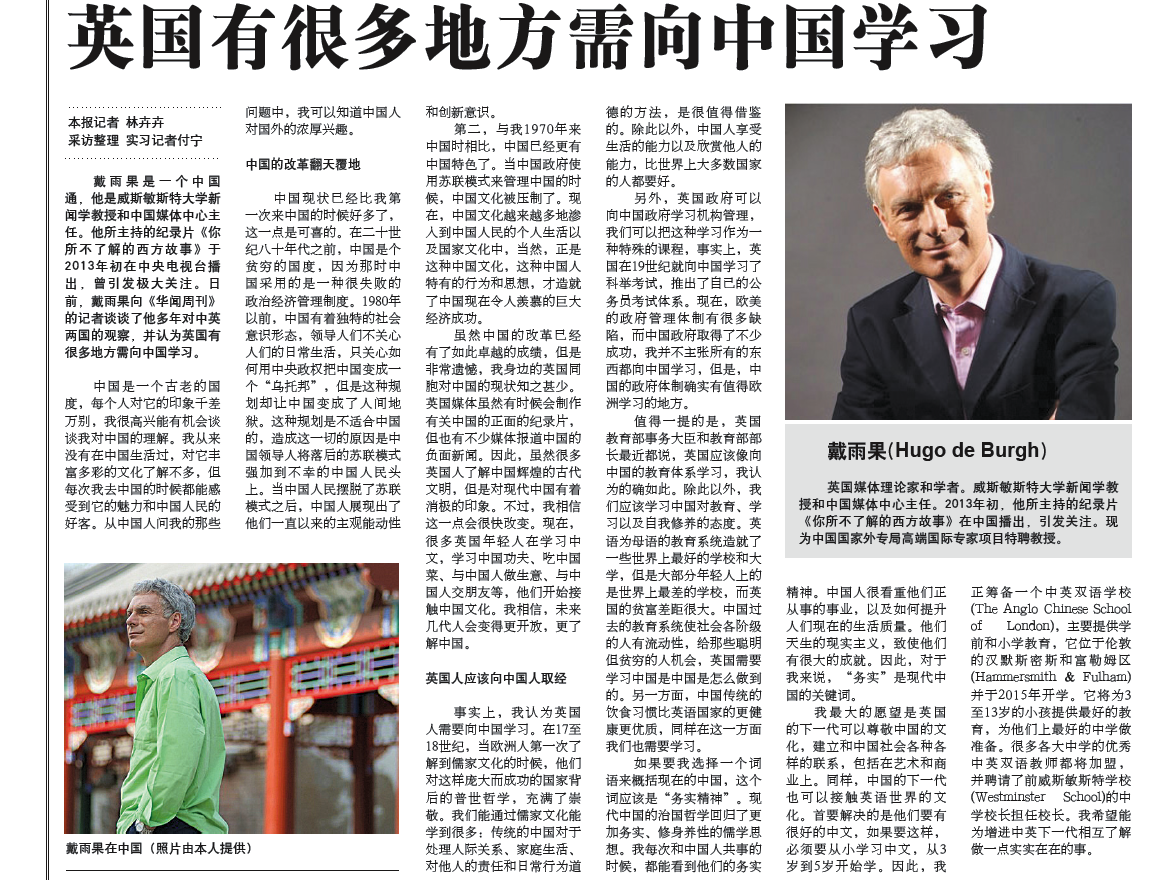
China through the London Eye – 英国有很多地方需向中国学习

China through the London Eye – 英国有很多地方需向中国学习

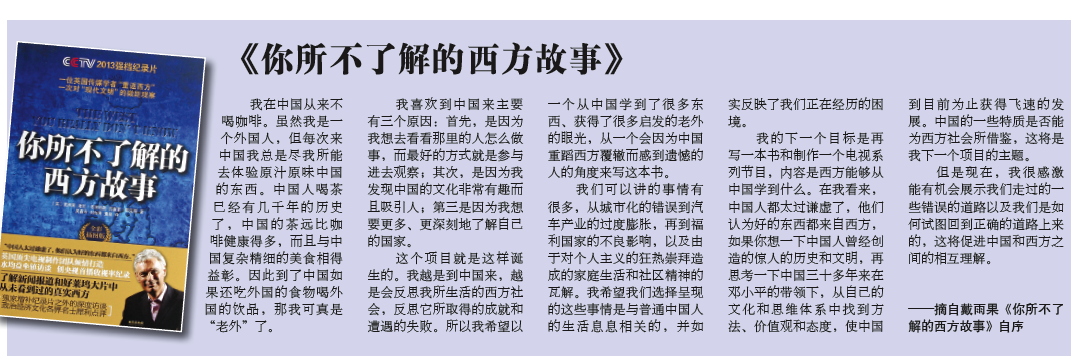
Please see Professor de Burgh’s interview in the Chinese Weekly on the following links:

http://www.ihuawen.com/article/12909

http://www.ihuawen.com/topic/479

Hugo de Burgh – Chinese Weekly article Jan2014

Picture 7


Picture 6


Related Images:

China: Literature and kamagra generique political reform

Today it was reported that Wen Jiabao, once again, has called for faster political reform at the end of the National Peoples’ Congress. There have been many political reforms over the past 30 years, to say nothing of social changes that have made the country more open. So what’s he worried about? Well, since he warned that he thought that turmoil of the order of the Cultural Revolution might be on the cards if China does not deal with this matter, he seems to be saying that the gulf between the power holders and the powerless is too great. That cataclysm was to a large extent about the fact that a greedy minority had got its hands on all the power and all the food and many people bitterly resented it. Sadly for the victims, the brutality was often deflected onto relatively powerless people, such as intellectuals on the survivors of the slaughter of the ‘bourgeoisie’ in the 1950s.

But today the situation is not the same. Vast numbers of people are much better off than before and the country as a whole is succeeding in improving life in every facet, which was definitely not the case before the 1980s.  Little by little officials are subject to scrutiny and procedures – from peer review to elections to the Freedom of Information Law – that oblige them to be more accountable. And New Media has frightened the baddies and encouraged good behaviour.

What Wen is probably worried about are two great gulfs; first that between the highly educated, public spirited and buy levitra 20mg overnight competent central government policy world and the local officials with their immense power and their inclination, as always in Chinese history, to enrich themselves; then there’s the gulf between the latter and ordinary people, who find their efforts to run their businesses stymied by corruption and political obstruction. The state is both catalyst of change but also able to stifle it. The Party interferes in everything too, from investment decisions to court cases, ostensibly on ideological grounds.

It’s not only the Chinese Prime Minister who is concerned. Our famous commentators, from Neil Ferguson to Peter Hitchens, Will Hutton to Jeremy Paxman all opine. Their underlying themes, it seems to me, are twofold: how will China use its power in the emerging world order in which the USA is not the ‘predominant hegemon’ to use a Chinese expression, and whether the Chinese political system is fit for purpose, or whether it will collapse under pressure from a dissatisfied citizenry and because of its inability to control corruption.

Martin Jacques in his thought provoking WHEN CHINA RULES THE WORLD has made a good start on thinking through the first issue, but on the second, raised onto the domestic agenda again yesterday by Wen Jiabao, our great commentators are not very satisfying not only because they hold to the ideological position that the only workable government model is that of Anglo-America, but also because it’s really hard to know what’s going on.

Among a few others, the American academic Shambaugh writes very well on Chinese government, McGregor has done a good book on The Party and Kerry Brown at Chatham House has published a stimulating book on elections in China,Ballot Box China. They all help scope the field and they all tell us about the brilliant people at the top.

But the book that offers a deep insight into Chinese government at the local level – for me, at any rate – is a novel. A Civil Service Diary by Mouse tells the story of a young graduate in his first years as the lowest of all civil servants in a poor rural parish. Badly treated by his superiors because he has no contacts, he struggles to serve the peasants in his charge by getting built the road which will link them to civilization, allow them to sell their produce, make enterprise worthwhile and raise their standard of living.

Every stage of his battle with bureaucracy, his search for funding, his efforts to persuade villagers to give up land and levitra sur ordonnance suede contribute labour, his persuasion of the planning department to hand over the specifications, his need to grease palms to get permissions – every one is there. The detail is riveting because it all rings true. Young Mr Hou is a very competent operator in a world in which interpersonal relations, the ability to build networks and the guile to avoid corruption and its attendant dangers are vital skills.

The novel hides nothing. There are officials who have the youngest and newest girls at the local brothel reserved for them; there are the fund managers who demand payoffs for releasing mortgages and grants; at one point a government investigation team beats up Mr Hou and tortures him with sleep and food deprivation.

But at the same time there are able and decent people fighting that China may succeed and brand cialis australia people get opportunities and material conditions that their parents could not dream of. You realise that what we call corruption can exist side by side with public spiritedness and dedication, sometimes in the same persons.

At the end of volume 1 Hou is elected to an important position in the teeth of the establishment, which does everything it can, bar breaking the law, to get his name expunged from the candidates’ list. Until Hou’s local colleagues submitted his name as a candidate with the requisite number of local signatures, no—one had ever stood against the official list. The local Party Secretary is incensed and his machinations as he tries to find ways of annulling or undermining the vote are comic; the shame of the official candidate who, in the elections, is knocked out by Hou, is awful, because we know that the ambitious competitor has built his hopes of future job security, achievement, marriage and reputation on winning.

There are 9 more volumes to go and I am going to read every one of them.

Today’s Chinese literary renaissance is like nothing so much as that of Victorian England. On this, I will keep you posted.

http://www.cps.org.uk/blog/q/date/2012/03/14/china-literature-and-political-reform/

Related Images:

LSE SU CHINA DEVELOPMENT FORUM 2012– China’s Reform Phase II 2012 中国发展论坛

As anyone who has talked with me about China knows, I am dismissive of British ruling class attitudes to China. Those who still write the country off as a totalitarian kleptocracy which has grown rich only by exploiting peasants,in which every half educated person is gagging to overthrow the regime, should attend a student conference on China.

This month I have attended two. At the Warwick Forum I was a speaker but at the LSE I had nothing to do but listen to the professors and editors from China and watch the audience. The level of the speakers at both events was high – economists from Tsinghua, LSE and Peking, sociologists and media people from Chicago, Peking and Hong Kong. None appeared to have any ideological baggage. They discussed China pragmatically:  it’s political system as one with both credits and debits; a people with the right and duty to work together with all other Chinese of good faith – and that includes most politicians – to iron out the problems that impede a commonly shared goal.

The audience listened intent, laughing at the incredible, taking issue with weak arguments, supplementing proposals. Hundreds wanted to ask questions, ideas poured out. The enthusiasm was everywhere. The conference went two hours overtime. It was supposed to be in English but about half way through everyone started talking Chinese and the interpreters found themselves servicing the English monoglots rather than the Chinese visitors.

The conference programme can be found on http://www.lsecds.org/forum/cdf2012/

Related Images:

Yan Lianke’s novel about politics and politicians

Many modern Chinese novels depict corrupt officials – the excellent description of the housing crisis in Shanghai, WoJu, A Home of My Own, for example, or the amazing series about the career of a young official, Guanchang Biji, Notes from Officialdom.  But it is the novelist Yan Lianke’s depiction of an ambitious young politician’s quest for advancement during the Cultural Revolution, Tough like Water, that, it seems to me, carries a fearsome message about Chinese politics and perhaps about politics in general.

His message seems to be that if there have to be professional politicians then it is essential to give them ways of advancing that do not require them to destroy those they want to supplant; it is essential to find ways of controlling them so that they do not sacrifice other people and everything they feel they need to destroy on their way to power.

In Tough like Water, Yan gives us the seizure of power in a village by a young, ambitious man during or before the 1970s. Because there is no mechanism for the transition to a new generation or interest group, he uses cruel methods and causes damage to many people in order to get his gang in and replace the existing power holders. The interests of the citizenry and society are completely ignored, although he always claims that he is motivated only by idealism and zeal to serve others.  It is a brilliant exposition of the mind of a politician, whose motivations and behaviour are similar the world over, though limited and channelled of course by the system in which he or she has to operate.

Gao, the protagonist, is an unprincipled, ambitious young thug of few abilities who therefore chooses the world of politics in which to succeed. Before the age of enterprise, politics or war were the main ways in which young men might make their mark. To himself, Gao justifies his urge to power by his desire to prove himself worthy of his mistress, the pretty wife of a neighbour, with whom he can reach the heights of sexual excitement when they are contemplating or celebrating his political victories.

Gao can only rise if he oust the power holders of his village and, since there are no elections, he can only do this by coup, which involves either killing them or destroying the bases of their power, and/or by impressing the policy makers at the higher level. Maoism gives him the tool in the right to attack, humiliate and ultimately destroy those who run the village; to keep up the pretence that this is an ideological struggle he tries to eradicate traditional customs, buildings and memorials. At one point he finds that someone has been burning incense and launches a witchhunt. The local chief is more concerned about Gao’s neglect of the farmland but Gao puts politics first.

There is a disaster looming in that the crops have been ignored in the enthusiasm to make revolution, ie change the powerholders. When warned that to expend energy pulling down the ancestral temple is not only a distraction at a time of crisis in the fields, but will also so alienate the peasants as to make it impossible to motivate them to work, Gao finds a compromise. He won’t actually pull down the temple but he will inflame a mob of his devotees – the yobs and misfits of the village – to break into the temple and burn the contents. As this in accordance with ideological instructions from on high, the old guard dare not stop it. What it achieves is that it demonstrates his, Gao’s, power. He is very happy to see burn the fruit of hundreds of years of scholarship and devotion, the records of past generations and the very soul of his village, for his temporary personal advantage.

Worse will come. The two cudgel their brains as to how they can topple the local chief, a be- medalled veteran of the Korean and Vietnamese wars,  and, carefully paying attention to his behaviour in meetings, suspect that he is having illicit relations with a woman official. In pursuit of evidence, they visit the chief’s home village (some two days’ distance, no telephones or email) where they are welcomed with generous hospitality as visiting officials by the villagers. Astonished by the relative affluence of the village – no-one is starving, there is even plenty of surplus food and there are unheard of luxuries in meat and eggs, they soon discover that, thanks to the chief, this village has never collectivised, but the villagers have been allowed to retain their own smallholdings rather than to work as the slave labour of an official, as elsewhere. No wonder it is so successful!

Feigning admiration, the visitors gather evidence on the grounds that this is a marvellous model which must be promoted widely; the success of it will certainly result in the chief being rewarded (after all, care of the peasants, ensuring their ability to feed themselves, must come first mustn’t it?). When they hear that the woman they wanted to pin illicit sexual relations on is in fact the chief’s sister in law, the wife of another army hero, they are even more excited; the naive villagers help their guests gather evidence of her involvement too.

The ambitious couple leave so thrilled that they just cannot stop making love in celebration;  in between bouts of passionate copulation they vie to promote each other to higher and higher positions and eagerly looking forward to getting staff posts in the hierarchy ‘without the duty to labour’. To the reader this is absurd. How can these runts imagine that, just by shopping an able official who has, by being unideological, managed to look after his charges, they can be promoted to senior positions? Yet so it is. The chief, war hero notwithstanding, and several of his associates get 20 years in prison camp – life with death, in other words – and the label of rightist which will plunge their families into the abyss of the persecuted forever. And the young upstarts are on a roll. Power is theirs. Chauffeured cars, big offices, the right to pull down buildings and rearrange gardens and make or break others will be theirs.

The author’s message here seems to be this: without a transparent method of selecting and promoting power holders, China is condemned to this kind of abuse.

The second point is that professional politicians are maybe always meretricious and immoral. Look at Tony Blair – he helped kill or main a million Iraqis to advance himself as an international celebrity. The protagonist of this novel works on a smaller scale, but the deal is the same.  This kind of person exists in every society; fortunate is the society that can harness their energies to constructive rather than destructive purposes and also, perhaps, force them to wait for power until experience has matured them into some sense of social responsibility.

As to ideology, it is what politicians use to advance themselves; their ability to persuade others of its validity is their skill; ideology can always be made to trump reality. Look at these English examples: dogmatic monetarism, multi-culturalism, ‘real books’ reading and ‘access’, all ideological positions with dysfunctional results for those over whom the ideologists want to exercise power.

Yan Lianke is a powerful writer about something that matters. Unfortunately the only one of his books so far in English is Serve the People, a story of how sexual passion breaks taboos and undermines political shibboleths.

Related Images: