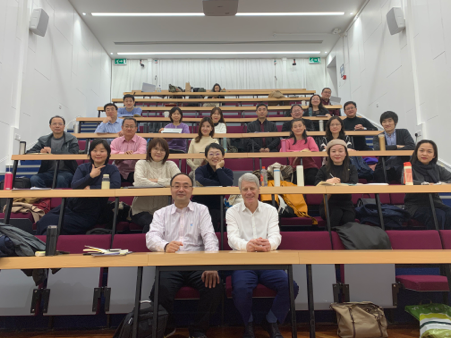
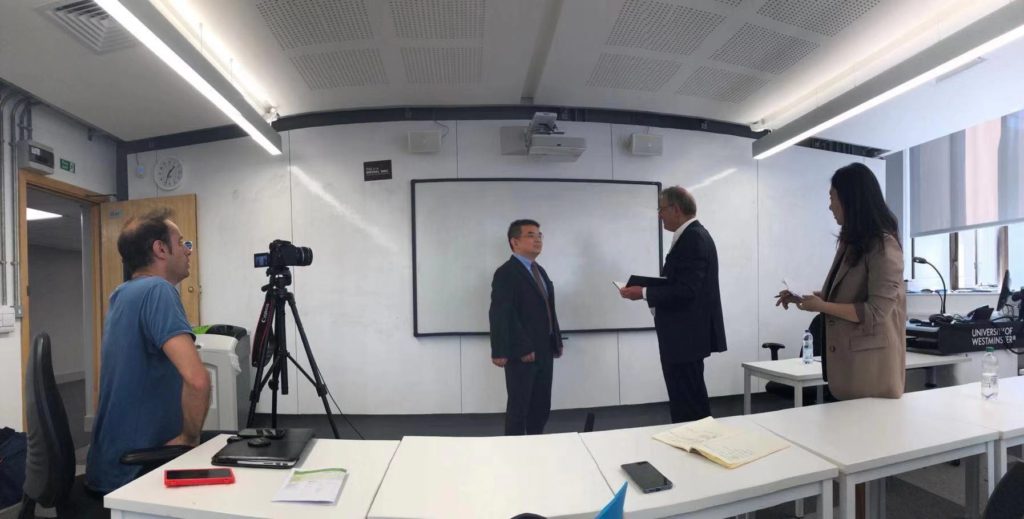
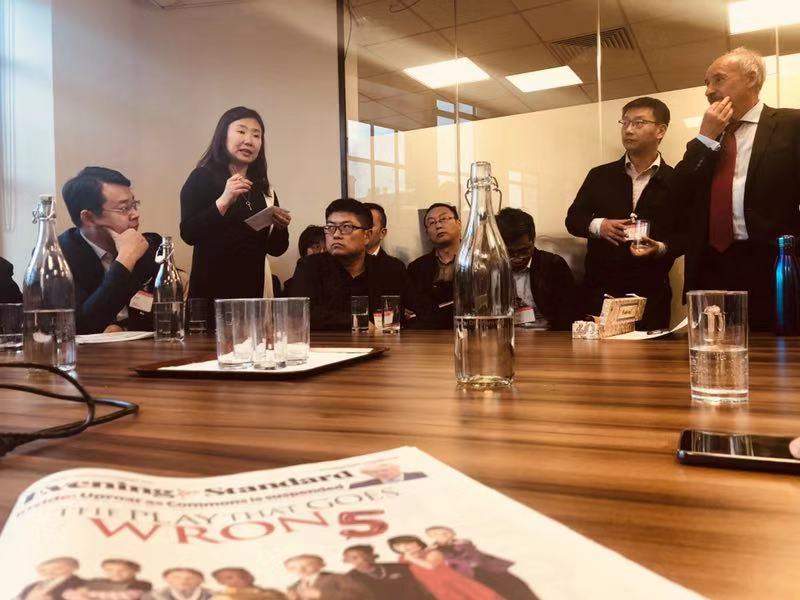
Nick Ross, one of the U.K.’s leading broadcasters, gave a lecture to Chinese media operatives undertaking a course in the China media centre today.
Nick Ross has been one of the most ubiquitous British broadcasters and cheap kamagra professional his best known for hosting the BBC television show Crimewatch for 23 years. He has made many documentaries and major series for both television and radio. He is chairman, president, trustee or patron of a large number of charities.
In his talk to the Chinese broadcasters, who included Yu Jianfeng, Director of the Tianjin Jinyun New Media Group, and Zhang Chenxiao, Deputy Director of the Internet Department of the The National Radio and Television Administration (NRTA), he discussed his experience of reporting in Northern Ireland as having relevance to Chinese media reporting controversial and critical situations in China. He talked about the origins of our relatively free media but also of the limitations of that freedom in self censorship and BBC ideology. He said that we need a middle way between the British media’s determination to ferment controversy and the Chinese media’s damping down of controversy. He believes that while China over regulates its media and clomid australia particularly social media, the UK has been discovering, as it grapples with pornography, poisonous ideologies and terrorism on social media that it has under regulated social media and has now to try to retrofit controls.
China’s National Science Prize awarded to UK graduate on the same day as her father
On Thursday 9 January 2020, China Media Centre PhD and screen producer Dr Zeng Rong received the P.R.C’s National Prize for Science, the highest such award in China.
This is the first time that the National Science Prize has been awarded to someone not a scientist.
The citation for the prize noted that Dr Zeng was the Originator and Executive Producer of two series of the acclaimed TV documentary series The Emergency Room. The award has been made in recognition of her contribution to public understanding of medical science
The Emergency Room is a large-scale medical documentary shot by fixed camera, which was jointly made by Shanghai Media Group and Houghton Street Media. The programme documents the front line of the emergency services, revealing the fragility of life and observes the consultation process of hundreds of patients, with materials shot 24 hours a day and 7 days a week using 78 fixed cameras with a team of over 100 production personnel.
Key members of the production team comprise Westminster media alumnae, including Producer Dr Mi Miao, Production Manager Li Mengyang and Director Wang Tong. Other Westminster alumnae involved in the series include Li Yingying and amex tadalafil drugstore He Sijia. (all women)
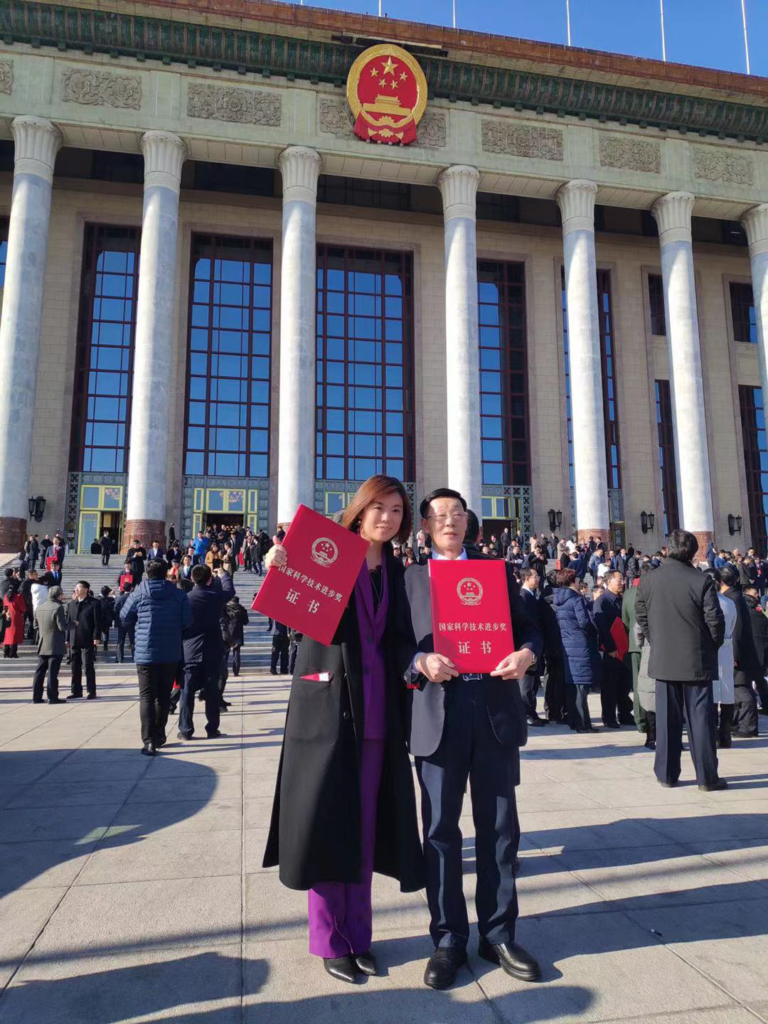
Dr Zeng received the prize at the Great Hall of the People in Beijing whilst in the presence of President Xi Jinping. Her father, cardiologist Dr Zeng Dingyin, received the National Prize for Scientific Research at the same ceremony.
Talking about her achievement, Dr Zeng Rong said: “I am delighted to receive this wonderful award at the Great Hall of the People. The Emergency Room has been one of the most influential television programmes about medical issues and the health services in China and we are very proud of the values and contributions it has made.
The China Media Centre has given me lots of ideas, skills and special vision of transnational culture and the media industry.” I am thrilled that my father was awarded a prize in the same year. We are both very proud and grateful.”
Notes:
ZENG Rong obtained her PhD under the Director of the China Media Centre (CMC), Professor Hugo de Burgh, with a comparison of Chinese and British television news. It was published in 2012 as TELEVISION NEWS AND THE LIMITS OF GLOBALISATION (UBP). She then worked as a Post Doc at the CMC and set up Houghton Street Media (HSM) in 2014 with a fellow alumnus of the LSE, where she had taken the MA Media. Very rapidly, HSM has become one of the most innovative independents in China, producing for many different platforms and often in cooperation with UK creatives and Production companies. It is probably the only independent in China with a Creative Development Team, devising comedies, chat shows and reality TV as well as documentary series. With offices in Shanghai and Beijing, it employs between 100 and 150 full time staff, many of whom studied media in the UK. The top management is entirely female.
The citation for the prize noted that Dr Zeng was Originator and Executive Producer of three series of the acclaimed TV documentary series The Emergency Room. Key persons of the series are Westminster alumnae, especially Li Mengyang (Production Manager) and Wang Tong (Director). Other Westninster alumnae working on the series include Li Yingying and He Sijia.
Making the day unique, Dr Zeng received the prize in the presence of President Xi Jinping at the Great Hall of the People in Beijing on the very same day as her father, cardiologist Professor Zeng Dingyin 曾定尹, received the National Prize for Scientific Research.
Dr Zeng Rong and Professor Zeng Dingyin in front of the Great Hall of the People in Beijing.
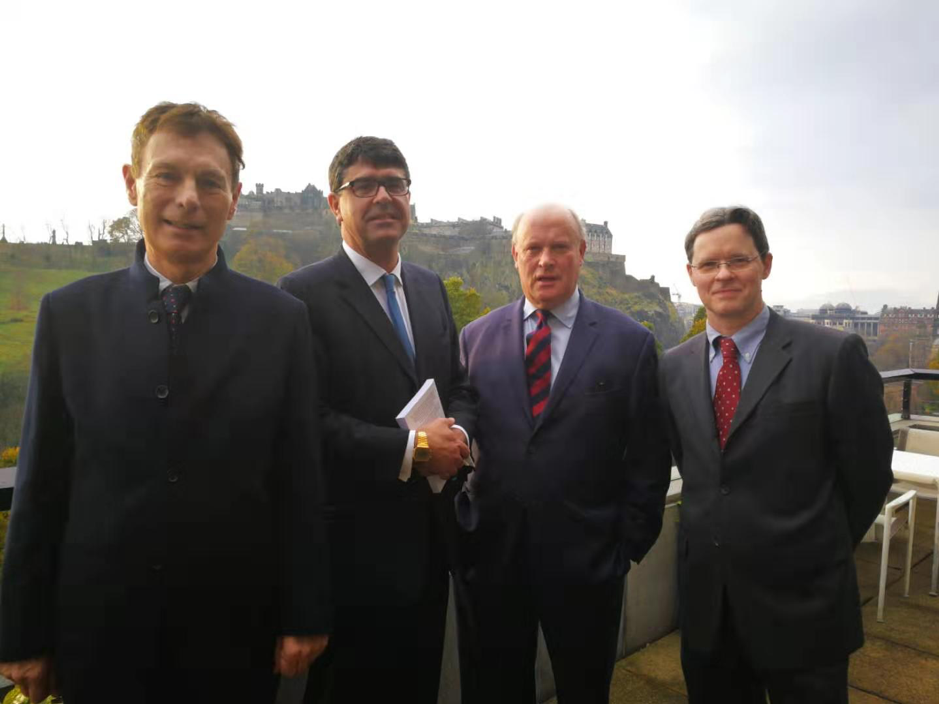
On 19 November 2019 Professor Hugo de Burgh gave a talk to the RSA Scotland in Edinburgh.
In the picture (from left to right): Hugo de Burgh; Adam Keswick, Managing Director of Jardine Matheson; Roddy Gow OBE, The Chairman and Founder of Asia Scotland Institute; Mure Dickie, the Financial Times, formerly based in China as China Correspondent of the Financial Times.
He addressed a number of issues including:
– What China’s media tell us about how Chinese society is developing and introduced several examples, including:
– Weirdo Says (a chat show for millennials in which not only are controversial topics battled over, but where rhetoric and debating skills count)
– Cui Yongyuan’s blog (covering hypocrisy in government pronouncements and using investigative journalism to uncover dealings)
– the fact that China produces more TV drama than any other country – but not about emperors and courtesans, the most popular series being All’s Well! and Good Husbands exposing tensions between family responsibility and modern living.
– The challenges of governance as wonderfully revealed by China’s Trollope, the writer of Civil Service Diary, a sixteen volume novel about the rise from obscurity of a young official.
Hugo de Burgh introduced examples from Internet platforms as well as offline media in discussing what China’s media today tell us about how modern Chinese think and feel.
In my introduction to the CMC’s training courses, I always suggest the delegates take the short walk over to 22 Frith Street where a blue plaque commemorates the house in which John Logie Baird first demonstrated television to the public. It seems wonderfully fitting they have come from the far side of the world to learn about TV so close to the spot where the medium was born.
Delegates watching RuPaul’s Drag Race UK
I don’t suppose we have anything to teach the Chinese about building a television set these days, but I do believe the creativity, professionalism, and flair of British TV professionals can challenge the delegates to raise their standards. The talented and hard-working Chinese producersmake the shows we make, but they don’t make them the same as we do. And their presence here in London indicates they want to see what they can learn from our practices.
The course starts by focusing on the development of new programme ideas, but not just any ideas, ideas that are fresh and bold, and have the audience’s needs at their heart. For producers from China, which in the past relied on importing – and sometimes copying – popular formats from the outside world, and where development can be a top-down process, this can be an exciting prospect. They certainly throw themselves into the task of brainstorming ideas with great enthusiasm.
Group discussions in a storytelling workshop
Next come sessions with some of the UK’s most experienced programme makers, who talk about their shows, their companies, and their careers. These are people who have followed their passions, moved freely between companies or started their own, and operated without the burden of ever-shifting government controls. The delegates might be shocked by the language, behaviour, and ideas in some of the clips they are shown (even tattoos have to be covered up on Chinese TV), but this is what television looks like, for better or worse, in the Anglosphere.
Pitching contributors at a session about casting
As the course moves towards its end, the delegates meet production specialists who are respected for their skills and experience, and usually don’t have to live with the tinkering of politically appointed bosses. They hear about a culture where the management of budgets, schedules, and resources is done solely to produce better quality, better value programmes, and any abuse of this trust would spell the end of a career or contract.
Another of my favourite introductory comments is to stress we are not trying to tell delegates what to do, but rather to explain what wedo and encourage them to decide for themselves whether it will work in China’s very different media landscape. As one of the delegates explained to me, “It has to be Emperor’s Palace not Buckingham Palace.”
Nevertheless, along with their purchases from Oxford Street, Princes Street, and Bicester Village, I’m hopeful the delegates will also take home the best that British TV can offer, and get many years of use from it.
Although CMC was set up to be a research centre within the existing Culture and Media Research Institute, it was tasked with being self-supporting after two years. So early on, we sought contracts for consultancy or professional development courses and our first client was the Foreign and Commonwealth Office.
The FCO tasked us to persuade the Chinese government’s State Council Information Office (SCIO) to let us brief Chinese media handlers in advance of the 2008 Olympics. Then the FCO would pay us to deliver briefings. We argued to the SCIO that their people really didn’t know what was going to hit them when China would be opened to the world’s media in 2008. Their spokespersons, media handlers and ‘press officers’ needed to be prepared. The SCIO agreed and we subjected around 600 of them tour briefings, the senior, national ministry, spokespersons were in London and lesser fry in China. In China our courses were led by Ivor Gaber, the former ITN Executive Producer who is Emeritus Professor at Goldsmiths and now also a Professor at Sussex; Steve Hewlett, distinguished broadcaster and radio host; Dr Paul Lashmar, Nick Davies and Paul Kenyon, famous investigative journalists in the UK.
Briefing media handlers and journalists is a relatively small part of our portfolio of courses today but Chinese organisations still find it useful. The courses encompass four themes:
The roles of the media in Anglophone societies and the principles which underly them, principles such as impartiality, adversariality and detachment. How understanding where Anglophone journalists are coming from is essential to those who must deal with them.
Assumptions about and opinions of China in the Anglosphere. Here we expose them to, for example, how our media treat the Dalai Lama, view the Hong Kong demonstrations or the South China Sea issue and report the Xinjiang internment camps. And we tell them why we have strong views on these matters!
How the media are organised and regulated and the advantages and disadvantages to the polity of having a ‘Fourth Estate’ such as ours.
How journalists treat spokespersons, what they want to know from Chinese officials and the techniques they use.
The fourth theme is realised through practical sessions, typically a press conference and a crisis management scenario. Media handlers are asked questions that they would never be asked by their own journalists, such as:
How do you account for self immolation by Tibetan monks?
Admit that the dotted line justification for your South China Sea policy is nonsense and that your policy is imperialistic
How do you think of the corruption of China’s high-ranking officials?
How would you explain PLA’s aggressive activities in South China Sea area?
Don’t you think one of the purposes of China’s Belt and Road Initiative is to take resources from poor developing countries in Africa and Latin America?
Censorship of Internet and violation of freedom of speech such as in the case of Ai Weiwei and muslims in the Xinjiang area.
Rapid economic development at the high price of environment, serious air and water pollution.
The replies are often more imaginative than formulaic and demonstrate that the course participants do not have homogenous answers – at least while they are on a programme in the UK. Crisis management sessions have a similar function because the crises invented tend to be those which expose the negative – environment, exploitation of workers, persecution of religious and so forth.
The most valuable lesson from the Chinese perspective is that the participants are forced to see the other point of view; in so doing, they question their own ways of and their own policies. That is not to say that they are persuaded that West is Best but that they reflect on the differences between our two systems. Chinese officials from Liu Shaoqi to Zhu Rongyi have often championed a free-er media and I believe that our courses help to keep alive the idea that there are alternatives.