CHINA TAKING OVER?

by Professor Hugo de Burgh

Empire: How Britain made the Modern World is the most succinct description of how today’s world came to be as it is. It will be a long time before a definitive exposition is written of how viagra generic China came to supplant that role. But a good many people are ready with the first drafts. Last week I listened to Stephen Green, Chairman of HSBC, tell the Vice Chancellors of Britain that the global balance was shifting.  A few days later, at the 48 Group New Year Celebration at the Dorchester, John Prescott, former Deputy Prime Minister, a couple of Ministers and prix ??de vente de viagra the top cheeses of two of our big companies said much the same. Martin Wolf and lesser wiseacres in the FT concur.

They may be in too fast. My Chinese friends, despite being avid watchers of the CCTV series ‘Rise of the Great Powers’ prefer to be modest about China’s ascent. They remind me that there’s a lot of poverty and that the recovery from 40 years of communist destruction is only just started. And there is a bevy of foreign China watchers, chaps like Will Hutton, who say it cannot possibly happen until China sorts out its politics and becomes like Britain, so there! But something big is happening in the world and the economic crisis has just accentuated it. Even if you don’t agree that China is about to displace the USA, then you may sign up to the widely acknowledged fact that the economic drive plus vast population of China poses some big challenges for the Anglophones, who, first under Britain’s leadership, and then the USA’s, have dominated, hard and soft, the world for a very long time.

The aim of this blog is to discuss the impact of these challenges on England. I will contribute some ideas regularly – but I’m also writing to all the smart cookies I know to ask them to write in.

Today I’m contacting two people I’ve just enjoyed discussing Barack Obama with on an inauguration day chat show – Diane Abbott the socialist MP and Peter Oborne the Tory polemicist and investigative journalist. And I’ll ask Stephen Green and viagra kaufen schneller versand the very bright China buffs from Pinsent Masons and Standard Chartered too. When we in the China Media Centre ran the Westminster Hearings on China’s Impact in Parliament last year one of the best speakers was Liu Mingkang, Chairman of the Banking Reform Commission. And so on. These guys have ideas worth hearing, arguments worth tackling. Happy New Year. And I, by the way, am an Ox.

QUESTIONS WE’D LIKE YOU TO ADDRESS IN YOUR CONTRIBUTIONS TO THE BLOG:

  • What are the challenges that China’s rise poses for this country? [do we need to change how we work, educate or provide social security?]
  • What can we learn from China? In what ways can each country’s culture be improved by learning from each other?
  • What kinds of cooperation are possible between this country and China?

Related Images:

International Communication Association, Singapore 2010 Preconference on the ‘Chindia’ challenge to global communication

22 June 2010

Conceived and organized by:

Daya Thussu, Professor of International Communication and Director of India Media Centre at the University of Westminster, London

Supported by:

Mass Communication Division of the ICA and by the Center for Global Communication Studies, Annenberg School for Communication, University for Pennsylvania

Call for papers:

The transformation of communication and media in China and India – the world’s two most populous countries and レビトラをオンラインで購入する fastest growing economies – has profound implications for what constitutes the ‘global’. Jairam Ramesh, currently India’s Environment Minister, is credited with the notion of ‘Chindia’, representing what has been termed as the ‘rise of the rest’. Trade between the two Asian neighbours – negligible at the beginning of the 1990s – grew to $40 billion by 2008, with China becoming India’s largest single trading partner. Such economic exchanges have coincided with cracks within the neo-liberal model of US-led Western capitalism. The combined economic and cultural impact of ‘Chindia’, aided by their worldwide diasporas, is creating globalization with an Asian accent, a phenomenon that is likely to influence globalized media and its study.

With more than 70 dedicated news channels, India has one of the world’s most linguistically diverse media landscapes, while China has emerged as the planet’s biggest mobile telephone market, having the world’s highest blogger population and as the largest exporter of IT products. The study of media and communication is rapidly growing in both countries: more than 700 communication and media programmes are operational in Chinese universities, while the opening up of the media and communication sector in India has led to mushrooming of media institutes. In addition, both www.tadalafilonlinepharmacyone.com countries provide a considerable number of media and communication postgraduate and research students to Western universities.

Though both countries have experienced different trajectories of growth in recent decades and represent two distinct political and media systems, they also demonstrate interesting similarities. The rise of ‘Chindia’ offers exciting opportunities as well as challenges to media and communication researchers. This preconference – a pioneering intellectual venture – aims to bring together scholars from around the world, especially from China and India, to examine and explore this phenomenon.

Among the topics we wish to cover are: The rise of ‘Chindia’ and its impact on international media research; globalization of Indian media and cultural industries; China’s soft power; communication and cultural exchange between China and India; re-envisioning diasporic and developmental communication; Chindia – cooperation or competition?

The Communication and Media Research Institute (CAMRI) of the University of Westminster, which was officially rated in 2008 as the UK’s top media research department, is home to both the China Media Centre and the newly established India Media Centre. This unique combination of expertise should ensure high-quality international participation, especially from China and India. A selection of papers presented at the preconference will be published in a special themed issue of the Sage journal Global Media and Communication.

Speakers to include: Professor Yuezhi Zhao, Simon Fraser University, Canada; Professor Daya Thussu, University of Westminster, UK; Professor Ang Peng Hwa, Nanyang Technological University, Singapore; Professor Bella Mody, University of Colorado in Boulder; Professor Hu Zhengrong, Communication University of China, Beijing; Professor Vibodh Parthasarathi, Jamia Millia Islamia, New Delhi; Dr Xin Xin, University of Westminster; Professor Oliver Boyd-Barrett, Bowling Green State University, USA and Professor Joseph Chan, Chinese University of Hong Kong.

Registration: Participants are required to pay a fee of $100, which includes tea, coffee and lunch, and the payment goes through ICA.

Prospective participants should submit an abstract (200-300 words) to Professor Daya Thussu (D.K.Thussu@westminster.ac.uk) and Ranita Chatterjee (R.Chatterjee@westminster.ac.uk) by 7 December 2009.

Related Images:

The Transformation of Chinese Media, Ideology and System Change

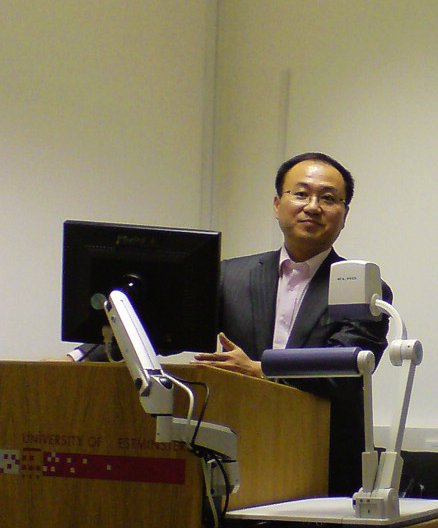
huzhengrong.jpg

CMC 2008 Autumn Term Seminars

The Transformation of Chinese Media, Ideology and System Change

Speaker: Pro. Zhengrong Hu

Date: Friday 21 November 2008

Time: 5-7 pm

Venue: Room A4.13, Harrow Campus

University of Westminster

Dr. Zhengrong Hu is a Professor in Communication and the Vice President of the Communication University of China (CUC). Prof. Hu is also the Director of the National Centre for Radio & TV Studies at CUC and the President of the Chinese Association of Communication (CAC). He is very well known in China and internationally as one of the leading scholars of media regulation. Prof. Hu was a Leverhulme Visiting Professor at CAMRI from February to August 2006 and a Research Fellow at Harvard University 2005-2006.

This seminar will be given in English.

If you have any inquiry about CMC events, please contact George Dawei Guo at georgedawei@yahoo.com.cn or call 020 8357 7354.

Related Images: