Two-Day Workshop on British Journalism at CCTV

cmc_ims_china_oct_09_1

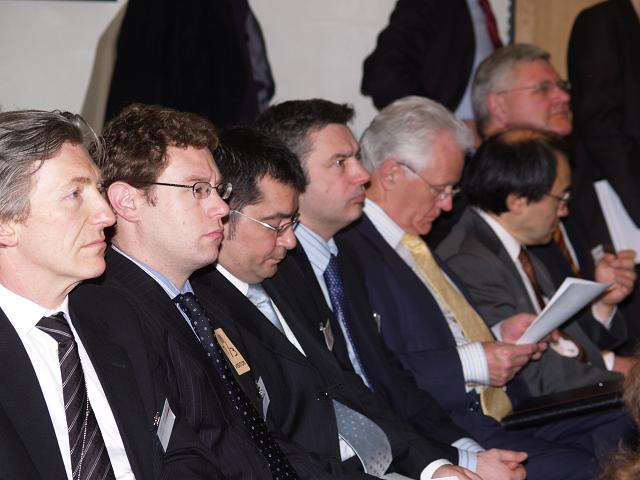
China Central Television was the venue for a 2-day Workshop on British journalism organized by China Media Centre in October 2009. Speakers were Hugo de Burgh, CMC Director, Kevin Sutcliffe, C4’s Head of Current Affairs, Steve Hewlett, presenter of BBC’s The Media Show, Zhang Jie, Editor of CCTV’s News Investigation and Yang Rui, Presenter of CCTV’s Dialogue.

Related Images:

Parliamentary Seminar: ‘China and the New Green Deal’

‘China and the New Green Deal’, a China Media Centre conference, was held in Parliament in June 2009. It was the 6th conference on China held by CMC in Parliament.

WH2

A one-day CMC seminar was held in the Houses of Parliament to address the implications of China’s management of its environmental challenges for government policy and British business. It was hosted by the All Party Parliamentary Group on China and sponsored by Norton Rose. 170 people attended, from business, the policy world and media.

One of CMC’s research themes, along with regulation, journalism and innovation in the media, is the relationship between media and environment. This seminar is one of several initiatives connected with this theme, including a workshop at Caijing magazine in  Peking, producing a report on journalism and the environment for International Media Support and being knowledge partner for the October Wilton Park Conference on China’s environment.

This is a conference of the China Media Centre for the APPCG, with Knowledge Partner, Norton Rose LLP. With assistance from the Chinese Embassy and sale uk viagra Chinadialogue http://www.chinadialogue.net/

Related Images:

CMC Connection: Boris Johnson

China Media Centre managed Boris Johnson’s first ever visit to China, to study higher education, just before he became Mayor of London

BJ9

Boris Johnson

The Mayor of London and former MP for Henley

伦敦市长Boris Johnson中国之行

BJ2In 2006 the CMC arranged Boris Johnson MP’s first trip to China, when he was Conservative Higher Education Spokesman. He and the Director of CMC travelled together to Shanghai and Peking where they were filmed by BBC Newsnight.

Photo: Boris Johnson in China

2006年,时任影子内阁高等教育部发言人、现任伦敦市长Boris Johnson 在中国传媒中心的安排下,与中心主任戴雨果教授一起,展开了他的首次中国之行;他们在上海和北京的行程由BBC的新闻之夜栏目(News Night)摄制成专题节目在黄金时间播出。

Steam-rollering into the future (Review of Hugo de Burgh’s China: Friend or Foe?)

Boris Johnson

Spectator, Wednesday, 28th June 2006

You’d better hurry if you want to see any of old Beijing. The lovely higgledy-piggledy brick hutongs are being blitzed in readiness for the 2008 Olympics. Even in the Hou Hai district, supposedly one of the last zones of ancient tranquillity, the imperial lakes are fringed with trashy bars and ugly black sound systems spilling on to the pavement.

Not far away tourists are taken to inspect the old codgers playing chess and mah-jong, surrounded by caged birds. The oldsters like to look at the birdies, the tourist will be told in a whisper. It was one of the simple pleasures that Mao destroyed. The dictator took it into his head that it was an act of bourgeois decadence even to admire birdsong or plumage. So children went around banging tin trays and the birds were driven from the trees.

BJ3

Photo: Boris Johnson joining in exercise at the Peking University.

As you look at these elderly victims of Maoist insanity, you can’t help wondering whether all the pundits are right about China. This is a place that still refuses to acknowledge the evil of Mao, and where his visage still hangs, fringed with tassels, from the rear-view mirror of buses. Are those mole-covered jowls really the face of the new China? Is it possible that this one-party state will achieve the kind of global dominance that some have recently forecast? In this clear, concise and fact-stuffed summary, Hugo de Burgh gives you all you need to make a pretty shrewd guess.

For those who think we’d all better take crash courses in Mandarin, the statistics are terrifying. China now consumes more red meat than any other country, and in the next five years will become a bigger trading nation than the US. Last year there were 50,000 miles of three-lane highway under construction, and new metro systems were being constructed in 26 cities, as well as 30 nuclear power stations. Shanghai has the world’s tallest hotel, the biggest shop, the highest television tower and 50mg levitra price usa the fastest train.

The Chinese middle class is exploding — I expect a thousand or so have been added to the ranks of the bourgeoisie since you began this article — and will number about 200 million this year. These are of course buying ever more cars, clothes and electrical appliances, and Goldman Sachs estimates that within ten years the Chinese will be buying 29 per cent of the world’s luxury goods. The Chinese are rapidly expanding their educational system, and they continue to excel in the crunchy subjects that British students find so off-putting. Almost 60 per cent of Chinese undergraduates study the sciences or engineering, compared to 36 per cent in the UK. How can they lose?

Well, as de Burgh points out, China is still a developing country, with per capita GDP of about $1,000 per year. We all have it in our heads that China is the world’s economic powerhouse; and yet the country is still afflicted by such poverty as to qualify for the world’s biggest slice of World Bank assistance. Never forget that the Chinese must feed a quarter of mankind with only 10 per cent of the world’s cultivable land, and with only 25 per cent of the global average per capita water supply.

That is why so much of China has been deforested or turned into a desert or a dump for nuclear waste, and the forced march to capitalism is producing anguish that can be every bit as painful as the Cultural Revolution. Villagers are killed if they protest against the expropriation of their land for development. In 2004 there were 74,000 protests of one kind or another, and yet there is no democratic outlet for these feelings.

Every university department has a party leader, every newspaper editor is under party control, and judicial decisions are subject to political review. Corruption is everywhere, tax is raised in a pretty arbitrary fashion, and a rickety social security system must cope with what promises to be the mother and father of all pensions crises — because each mother and father is only allowed one child, with the result that 27 per cent of the population will be over 60 by 2050.

Feed all these factors into your equation, and you begin to see why there is a case for a moderate sinoscepticism, a belief that all this hysteria about China may be slightly overdone. As Hugo de Burgh rightly concludes, there is no reason to fear China. She is no foe. He provides ample evidence that her march to global dominance will take much longer than some are currently predicting, and that in the meantime her integration to the capitalist system has been, on the whole, good for China and good for us. It’s Win Win, as some snazzy new Beijing nightclub has no doubt been auspiciously named.

Related Images:

Media Digest, Feburary 9-15, 2010

TVCC of CCTV on fire

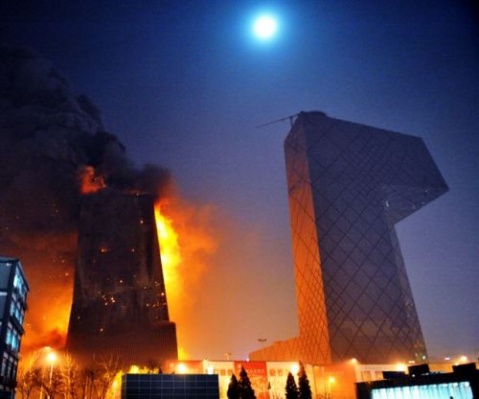
tvcc-of-cctv-on-fireThe northern building of the new CCTV complex was caught fire on Feb. 9, at around 8:00pm. The fire spread quickly and soon the entire structure was in flames.

The 44-storey building, about 200 meters from the iconic CCTV tower, houses the Television Culture Center (TVCC), the luxury Mandarin Oriental Hotel and an electronic data processing center.

According to Juliet Ye of WSJ, “people packed China’s online forums and blogs, uploaded pictures taken from the fiery scene and hit the streets to conduct their own reporting.” You can also find some collections in Danwei, or CNReviews, and “A Photo Play Of The CCTV Fire”, from ESWN. Click here to see the video filmed by BBC staffs.

The incident hasn’t been featured all that prominently on news portal front pages. An unproven guideline on the fire report was distributed online,

“All networks:

Regarding the “CCTV New North Side Building on Fire” report, all sites must use only the Xinhua news script. Do not post pictures, videos; do not report in depth; only post in Domestic (Chinese) news; close all posts and kamagra preis deutschland replies; do not put this as the “top topic”; do not place this in “Recommended Articles”.” — source: CNReviews.com

It turned out that CCTV itself is responsible for Monday’s massive fire (via China Daily). At the day after the fire, an office director at CCTV and 11 others have been detained by the Beijing police for questioning, according to state news agency Xinhua. Chinese continued to dissect the event online with a sardonic tilt. See EEO’s story about Chinese online reaction.

Via China Digital Time,

China’s young and hottest blogger Han Han (韩寒) took fire at CCTV once again. This blogpost, written on Feb. 11, has once again been deleted from his Sina blog, but remains on the recently “resurrected” Bullog International website (hosted in United States.) The witty, sarcastic content is being re-posted by thousands of netizens within the Great Firewall.

You can find Han Han’s article in English (translated by CDT) in the link above.

The China Blog of TIME, “The Problem With CCTV” mentioned a pointed critique of one recent CCTV program after the fire.

Publishing still hot

China Daily says, Publishing still hot on bourses,

If you think the publishing industry is going irreversibly downhill in this Internet age, think again. It is fast becoming one of the hottest sectors in the Chinese stock market, thanks to government support, in a big way.

The State Council issued a new provision last year to support development of the culture industry. It is believed that the policy has underscored the future profits and development of publishing companies. Below is another news about publishing industry in China, “Media reform in China by the end of 2010, says GAPP”,

“By the end of 2010, all for-profit news media and publishing entities will be decoupled from the government institutions they are affiliated with and transformed into separate companies. The government will no longer place restrictions on them in terms of ISBN numbers, publication licenses, and content.”

Journalist “black list”

Via Reuters,

Li Dongdong, a deputy chief of the General Administration of Press and Publication, told officials that proposed strengthened regulations for Chinese journalists would include a “full database of people who engage in unhealthy professional conduct”, the China News Service reported.

“People entered into the transgressor list will be excluded from engaging in news reporting and editing work,” the report said, citing Li.

Other links you might be interested in

The China Media Digest is released by China Media Centre weekly.

Related Images:

CMC Seminar: Representations of China in the UK Press

China Media Centre 2009 Autumn-Winter Seminar

Representations of China in the UK Press

untitledSpeaker: Prof. Colin Sparks
Date: Wednesday 18th November, 2009
Time: 2.00-4.00 pm
Venue: MHW_A4-4 Harrow Campus,
University of Westminster

Abstract:

The Chinese government, together with many ordinary Chinese people, particularly students, are frequently angered by the way in which China is portrayed in the western media. This anger, however, is a response to the coverage of particular incidents and is not based on real knowledge of how China is covered on a day to day basis.

This presentation reports on a project that made a start on a more systematic study of the subject. The analysis covers the UK national press reporting of China during 2008 and presents data on the frequency and distribution of stories. It also reports a more detailed qualitative study of China in the elite and popular press, demonstrating that analyses concentrating on small-circulation up-market newspapers risk seriously misrepresenting the ways in which China is portrayed in the press. The seminar will be in English but some of the material is available in translation.

Biography:

Prof. Colin Sparks has worked with and advised the European Union, Unesco, the Open Society Foundation, the Rockefeller Foundation, the British Council, Universities in the US, Europe and East Asia, and many other organisations, academic, official, and non-governmental. He was one of the founders of Media, Culture and Society, and he continues to play an active role as managing editor, as well as editing issues on a regular basis. He was also a founder of the European Institute for Communication and Culture. He has organised several of its colloquia, and edited themed issues of its journal Javnost/The Public.
His current research interests include the comparative study of media systems undergoing rapid change. He is particularly interested in comparing the media systems of post-communist countries with those of other societies that have moved away from different forms of dictatorship towards more democratic forms of political rule. His other major current interest is in theories of media and communication.

(more about Prof. Sparks, see https://chinamediacentre.org/about/staff/colin-sparks/ )
If you have any inquiry about CMC events,  please contact Miao Mi at m.mi@my.westminster.ac.uk.

Related Images: