China Media Centre 2010 Spring Seminar Series 3

CHINA: SOCIAL MEDIA AND POLITICAL PARTICIPATION

Speaker: Dr. Bingchun Meng

Date: Thursday 8th March, 2012

Time: 2-3.30pm

Venue: A6.5, Maria Hewlett Building (A Block), Harrow Campus

Chair: Prof Hugo de Burgh

OPEN TO ALL

In this presentation, Dr Bingchun Meng will first lay out some of the theoretical debates as well as methodological challenges regarding the research of mediated citizenship. She will then draw upon my two recently completely projects, one on online spoofs and online pharmacy cialis generic another on a peer production community on the Chinese Internet, to offer some empirical materials for reflecting on the issue of mediated citizenship. Dr Meng will conclude with a few thoughts on future research agenda.

Biography:

Bingchun Meng is a Lecturer in the department of Media and Communications at London School of Economics and Political Science. Her main research interests lie in communication governance and media production, both of which are examined in the context of globalization and technological shifts. There are three strands in this research: 1) What are the institutional responses to the challenges brought by new communication practices such as disturbance to political control and subversion of the conventional business model; what are some wider ramifications of such responses? 2) How have the institutional arrangements of media production changed in response to the local and global conditions and clomid buy how the change affects the content being produced. 3) Media production at the grass-root level. How citizens exploit the opportunities afforded by digital technologies to expand their cultural and political participation, which, in different social contexts, may be constrained. These lines of research are connected by a general inquiry into the power dynamics operating at the macro- and micro-levels in communication networks.

Before joining LSE, Dr Bingchun Meng was a post-doc fellow at the Annenberg School for Communication, University of Pennsylvania, where she worked at the Centre for Global Communication Studies and also taught courses on Chinese media. She obtained her PhD in Mass Communication from the Pennsylvania State University.

If you have any queries about CMC events, please contact Miao Mi at m.mi@my.westminster.ac.uk

Related Images:

China Media Centre 2012 Spring Seminar Series 2

‘EVERYTHING DEPENDS ON LOVE’:

CHINESE CHRISTIANITY AND THE PARTY

Speaker: Dr GerdaWielander
Date: Monday 5th March
Time: 2-4pm
Venue: A 6.8 Maria Hewlett Building (A Block) Harrow Campus
Chair: Prof Hugo de Burgh
OPEN TO ALL

This talk asks the question what influence Christian values have had on social and political values in post-socialist China. Christianity, understood as an ideological source of social and political values, informs both official ideology and ‘dissident’ ideology, albeit in different ways and to a different extent, and is an increasingly accepted source of social moral and ethics in contemporary China. I argue that while we tend to think of China as an atheist, secular state, it is in fact vital to understand the importance religion plays in the state’s response to emerging new values in society without giving ground in terms of a more democratic system.

Biography:

Gerda Wielander’s research interest lies in contemporary China’s social and political development. Most recently she has been interested in the way Christian belief is influencing and free samples lasix shaping political discourse in contemporary China. She has published several articles in this field and has been awarded an AHRC Fellowship in 2012 to complete her book on Christian values in Communist China (to be published with Routledge in 2013).

GerdaWielander was educated in Vienna and Beijing. She obtained an M.A. in Chinese Studies in 1990 with a dissertation on Liang Qichao’s historiography, including a first translation into German of Liang’s “XinShixue” (New Historiography). Her PhD (1995) investigated the Malaysian Chinese evaluation of China’s Democracy Movement (1976-1989) as expressed in the region’s vibrant Chinese press.

Gerda is Principal Lecturer in Chinese Studies and Director of the Undergraduate Languages Programme in the School of Social Sciences, Humanities and Languages. She has taught at a number of British universities including SOAS and Cambridge before coming to Westminster in a full-time capacity.

More about China Media Centre and seminars see https://chinamediacentre.org.

If you have any queries about CMC events, please contact Miao Mi at m.mi@my.westminster.ac.uk

Related Images:

SOAS&CMC Spring Seminar:

The next China Media Centre seminar will take place on Wednesday 22rd February between 4-6pm at Westminster University’s New Cavendish Campus, in room C1.04.

Prof Michel Hockx from SOAS, University of London, Dr. Mei Hong, Assistant Professor from Southwest Jiaotong University and Prof David Gauntlett from University of Westminster, will give a talk with the title ‘China: the New Media Explosion’, You can find more details about the speakers and an abstract of the talk below.

SOAS& CMC 2012 Spring Seminar

CHINA: THE NEW MEDIA EXPLOSION


Speaker: Prof Michel Hockx, Dr. Mei Hong

Interrogator: Prof David Gauntlett

Date: Wednesday 22nd February, 2012

Time: 4-6pm

Venue: C1.04 New Cavendish Campus, University of Westminster,

Chair: Prof Hugo de Burgh

OPEN TO ALL


ABSTRACT:
This lecture introduces the history, development, and widespread popularity of Internet Literature (wangluo wenxue 网络文学) in the People’s Republic of China. The speakers will deal in turn deal with two discrete aspects of the phenomenon, namely the rise of online popular fiction and its impact on other media, and the significance of online practices for the more marginal genre of poetry.

BIOGRAPHY:
Michel Hockx is Professor of Chinese at SOAS, University of London. Born and raised in The Netherlands, he obtained his PhD in 1994 from Leiden University for a thesis on modern Chinese poetry. His later work has dealt with various aspects of the sociology of modern Chinese literature, including the study of early modern literary societies and literary magazines and, more recently, the study of Internet literature. His monograph Internet Literature in China is forthcoming with Columbia University Press.

David Gauntlett is Professor of Media and Communications, and Co-Director of the Communications and Media Research Institute, at the University of Westminster. His teaching and research concerns people’s use of media in their everyday lives, with a particular focus on creative uses of digital media. He is the author of several books, including Creative Explorations (2007) and Making is Connecting: The social meaning of creativity, from DIY and knitting to YouTube and Web 2.0 (2011). He has made several popular YouTube videos, and produces the website about media and identities, Theory.org.uk. He has conducted collaborative research with a number of the world’s leading creative organisations, including the BBC, Lego, and Tate.

Mei Hong is a vice professor of Communication Department of Art and Communication College, Southwest Jiaotong University, China. She obtained her PHD in 2006 from Sichuan University for a thesis on Culture and Communication. She is interested in media and society and has published a book on Internet Literature.


More about China Media Centre and seminars wee: https://chinamediacentre.org/

If you have any queries about CMC events, please contact Miao MI at m.mi@my.westminster.ac.uk


Related Images:

Jeremy Paxman and Bai Yansong spoke at the Future of Public Media workshop in Beijing

China Media Centre hosted leading TV stars as they shared insights on the opportunities for potential China-UK media partnerships

Jeremy Paxman (principal news and current affairs presenter, BBC), Wang Hui (Head of Communications, City of Beijing) in the chair, Bai Yansong (principal news and current affairs presenter, CCTV)

Jeremy Paxman and China’s leading current affairs presenter and writer Bai Yansong joined Paul Jackson and David Morgenstern, from the UK television industry, at the the Future of Public Media workshop organised by the China Media Centre of the University of Westminster and the Communications University of China. The event took place in Beijing, China, on 12 January 2012.

The full-day workshop explored common experiences and challenges facing public media organisations in China and the UK. Contributors came from academic, journalistic, policy and business backgrounds and investigated where common interests and potential partnerships can exist despite real differences in media systems, giving participants the chance to identify areas of common interest and build the foundations for future partnerships.


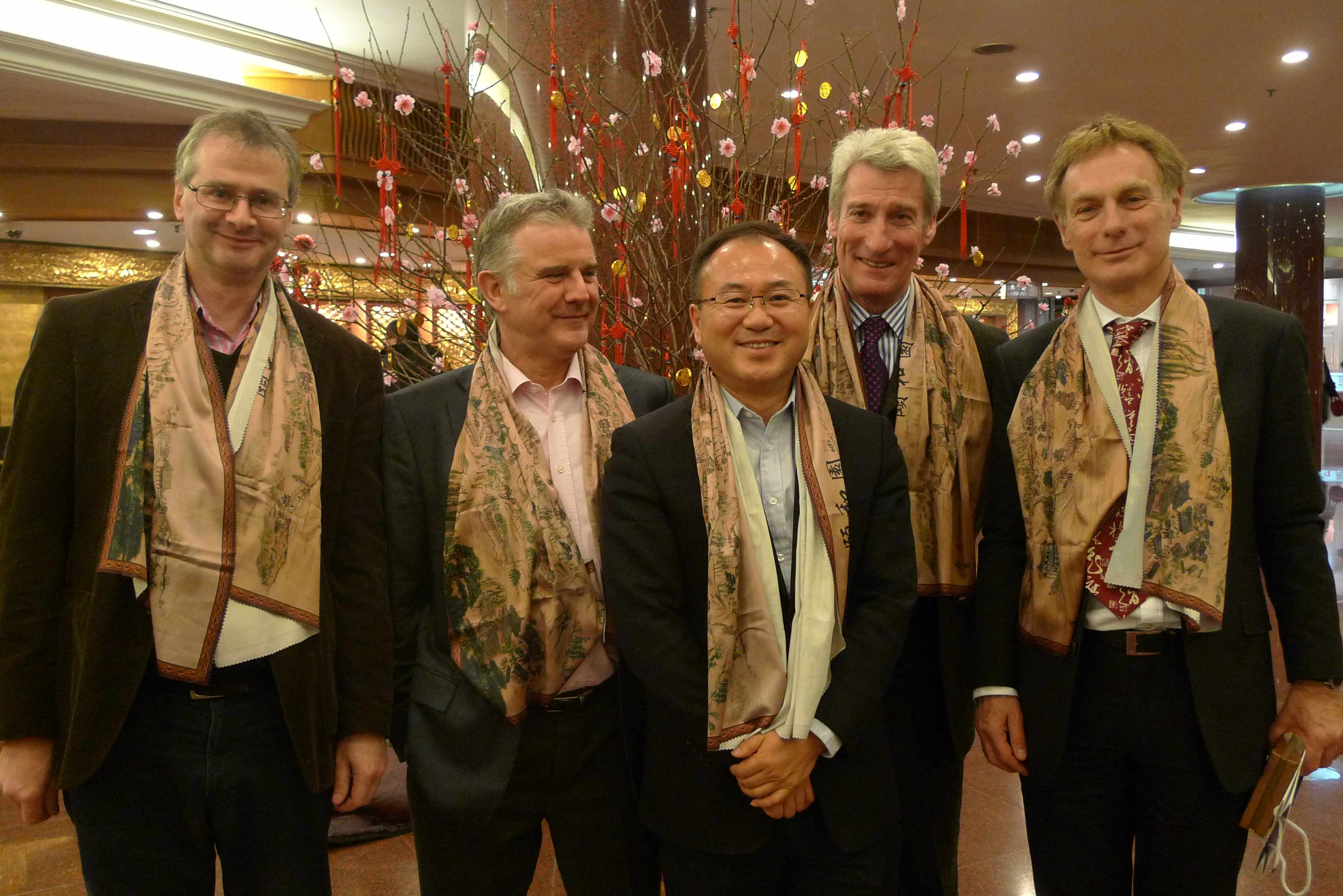
The four visiting British speakers at the conference, with the Conference Director, Professor Hu Zhengrong. (From left to right: David Morgenstern, Paul Jackson, Professor Hu, Jeremy Paxman and Professor Hugo de Burgh)

Key speakers attending the workshop included:

From the United Kingdom

  • Jeremy Paxman, the UK’s leading current affairs presenter.
  • Paul Jackson, an outstanding UK TV producer, former executive producer of BBC and ITV’s entertainment departments.
  • David Morgenstern, former director of BBC’s entertainment programme development department, currently Director of 10 Star company’s Programme R & D Department.
  • Prof Hugo de Burgh, Director of China Media Centre, University of Westminster.

From China:

  • Prof Hu Zhengrong, Deputy President of Communications University of China, Chairman of Chinese Media Research Association and the Honorary Doctor of the University of Westminster
  • Bai Yansong, China’s leading current affairs presenter and writer.
  • Yang Hua, Deputy Director of the CCTV News Centre
  • Zhang Haichao, Deputy General Manager of China International Television Corporation (CITVC)
  • Ren Xue’an, Deputy Director of CCTV Channel 1

Related Images:

Director’s Blog Day Two

China’s culture industries.

Last month the 4 day annual meeting of the Central Committee took place with the theme of enlivening the ‘cultural system’.

Chinese culture, in the sense of publishing, artworks and the appreciation of historical artefacts is developing very richly without any need of the Central Committee. New schools and universities are being launched while existing ones expand and clone and introduce new ideas and new pedagogy. So what is there for the Central Committee to discuss?

Two things. What significance the ‘culture industries’ have for China’s economic development and what role the very important institution, the Culture Establishment or culture xitong, will play.

The concept of the‘culture industries’ was invented in Britain but has been seized upon by Chinese intellectuals and policy makers (usually with acknowledgments to its parent) to emphasise the importance of the softer industries. Most officials in China will by now know that they are to be judged not just on how many miles of road are built or factories put up under their watch but on the concert halls, artist villages, animation companies, museums and so forth they can initiate.

Whereas money put into universities to work on the creative industries in the UK would doubtless result in the recruitment of more people to write turgid papers which nobody would read except the colleagues judging the writers’ ranking in the next Research Assessment Exercise, Chinese universities seem to be getting stuck in to their own projects with the local communities and individuals, spawning enterprises and workshops. There is a good deal of interest too in how you initiate and incubate creativity. One university plans to bring out some British psychologists and teachers to run a workshop on just that and my own organisation has been briefing broadcast executives on how small British companies are so productive of ideas that the UK is the world’s largest exporter of programme formats.

Some scoff at the Chinese as potential innovators, damning their ‘authoritarian’ political culture and ‘memorising’ schooling as impassable barriers. Like Bill Gates, reported to have said that ‘no-one was ever creative who didn’t have his basic maths and grammar right’, I’m not so sure. Any society whose food is as varied, evolving and imaginative as China’s is innovative in the deepest sense that they can apply their creativity to everyday life. Our summer school students,usually 2nd year undergraduates, astonish British lecturers when they are sent out to direct, shoot and post produce short videos and again when they have to think up ideas for television entertainments and get them judged by British Commissioning Editors. They are nothing if not imaginative and, what’s more, they realise their imaginings with enterprise, energy and the ability to apply themselves and master new skills, both dispositions learnt in a very demanding education system.

In the luxury design side of the culture industries Chinese consumers are buying Hermes and Burberry and Vuitton now because they are the best, but regular visitors to China daily witness new products and new brands which are applying internationally proven methods to their own workmanship. Its just a matter of time and trouble…….. What does this matter to us?

We have to face it that the comforting idea, that where brain and sparkle are needed we Westerners can always stay one step ahead even if all our basic necessities are produced more cheaply and efficiently in China, needs rethinking. Of course most of China’s exports are still made up of things designed by Westerners but this won’t last forever. Little by little Chinese are going to be doing their own conceptualising, research and designing. The government is also determined to reduce the exposure of China’s economy to the influence of the West, by powering the domestic market. If Chinese consumers can be spending enough to marginalise foreign buyers and if the things that Chinese consumers want are mainly to be conceived as well as produced in China then where does that leave the West? Ok, this is a reasonably long-term scenario, but it is one that our political leaders need to be thinking about.

And what about the Chinese government’s ability to realise its policy aspirations? Far from having a dysfunctional political system, as almost every foreign correspondent seems to think, China may have the edge on us institutionally too.

The Culture Xitong – the Administrative Framework for Culture – is led by the Central Propaganda (Information) Department.

There is a presupposition widely adhered to in Chinese society that culture must be supportive of authority and that it is one of the duties of government to use such media as are at its disposal to educate and inform the public as it see fit.

This approach has a number of facets which can seem to outsiders, at least to those from the Anglosphere, remarkable. For example, every city government will have a section responsible for spiritual development and civilised comportment, which will promote cleanliness, courtesy and good behaviour among citizens, through campaigns, competitions and public events. Communist media theory aside, officials who are as attentive to detail as this understandably also regard it as their duty to ensure that opinions are guided and that information that is subversive of interpersonal morality or good administration is excluded from publication. Regulating public communication is tasked, because of the legacy of Communist organization, to the Central Propaganda Department (CPD) of the CCP (MacGregor 2010: ch8).

As an illustration of the power of the CPD it is notable that, in early 2011, when it was widely reported that Prime Minister Wen Jiabao had visited petitioners at the State Bureau of Letters and Calls [国家信访局] to show his concern that petitioners against injustice were not being treated appropriately by many local authorities, Chinese observers reported that the Central Propaganda Department had criticised the Prime Minister for so doing, a surprising but not unprecedented revelation. The year before it had been reported that parts of Wen’s speeches had been censored on ‘at least four occasions in recent months’ (Moore 2010). These incidents give an idea of the authority attributed to the Propaganda Department.

Quoting a Party publication, Shambaugh comments that its definition of the CPD

‘means that virtually every conceivable medium that transmits and conveys information to the people of China falls under the bureaucratic purview of the CCP Propaganda Department. This includes all media organs, all schools and educational institutions, all literary and art organs and all publishing outlets.’ (Shambaugh 2009: 107)

The CPD is responsible for (1) issuing instructions on content, (2) the professional development of content managers (editors, publishers) and for (3) monitoring the content of communications to ensure that they do not transgress the official line on topics that the Party considers important. It has units at every level of administration of which local newspapers and broadcasting channels must take account. The CPD answers for the xitong of information and cultural institutions to the most powerful decision-making body in China, the Standing Committee of the Politburo of the Central Committee of the CCP.

It guides and supervises the xitong members (Perry 2001: 27-8), which include: the State Administration of Radio, Film and Television, the State Administration of Press and Publication, the State Council Information Office, the Ministry of Culture, Xinhua News Agency. It shares with the Ministry of Public Security the task of filtering and monitoring the Internet. Each of the organisations will have provincial and local branches. There is in other words a comprehensive structure through which to influence ‘culture’.

While my description above may imply that the powers of the CPD are all negative, all about exercising control, that is not necessarily the case today. New ideas about how culture can be developed both to enrich everyday life and to create new industries are shooting through the xitong; enterprising officials are encouraged and professional development courses and workshops are held to vitalise local committees and stimulate entrepreneurship. While it may be the case that ideology and hierarchy will have a stultifying affect, as China’s critics assume, this is not necessarily so.

The Central Committee believes that officials in Beijing can kick into fast gear a renaissance in culture that creates modern industries and diverts people from admiration for European culture into applying modern technologies and commercial skills to their own. The Central Committee may not be so wrong.

Related Images: