Yang Qing–Communication University of China
Before I start this article, firstly I want to show my appreciation to both the University of Westminster and Communication University of China for giving me the chance to visit and study in London. Since the Olympic Game was held in London, it was really once in a blue moon chance to experience the event in the exotic border.
 The 21-day visit to London had come to an end, but never would its impact on me. Sipping a cup of English tea, strolling along the Thames in the afternoon, I soon fell in love with London for its rich culture and profound history. My perception of London also grew as I explored more in the city.
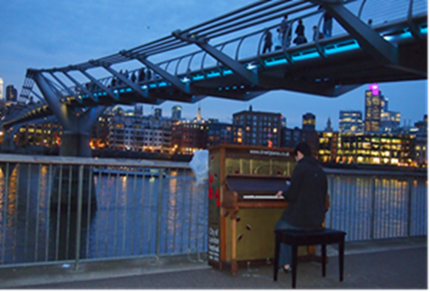
The cruise to the Greenwich began to sail on the Thames. There was no trace of the heavy smoke emitted from the chimney. Way ahead Tower Bridge shed huge shadow onto the river silhouetted against the sunset. To my surprise, many high-rise apartments or skyscrapers did not dominate the city as I used to expect. Instead, it retained more tranquil path flanked by European-style houses. And I knew so well that British people must be proud of their royal culture, as the glory of the well-preserved Tower of London never faded away. Exquisite posters and advertisement of dramas, plays, exhibition could always find their way on the tube station wall, and one of them even led me to the fascinating The Phantom of the Opera. And that Taming of the Shrew played in the Shakespeare’s Globe survived hundreds of years seemed to tell me something. As I wandered around the corner at the Millennium Bridge, I saw a man strike up a tune at the street piano. All of a sudden, the picture above explained everything — that London, with its confidence, was willing to give up modernity but retain its classics and tradition.
“Cultural mosaic” was the phrase struck in my mind when I got along with the people here. People seemed to blend in quite well because London preserved the individuality of cultures. I heard songs played by Mexican street performer flow through the Metropolitan line. I threaded my way through the Trafalgar Square on the “Canadian Day”. I even got a bit confused when the waitress with a Polish accent explained to me which fish and chips tasted best. Racial diversity was not a problem here, for London was a tolerant city.
Yet, what impressed me most was London’s great courage to reposition itself in the international arena.
Great Britain was always a trendsetter in its past glory. Shakespeare made enormous influence on world literature; Glorious Revolution marked the advent of modern democracy; Adam Smith’s Wealth of Nation established the foundation of economics; Industrial Revolution accelerated social productivity. All these had tremendously changed the world we lived in. However, no longer was “The Sun Never Sets”. After Great Britain had reached a peak of colonization, it soon plummeted to the worst after the Second World War. Then it was steered back to revival in times of Margaret Thatcher and flourished under the political manifesto of “New Labour, New life for Britain”, a slogan for repositioning Great Britain by Prime Minister Tony Blair. But today, London, as the capital of Great Britain, is eager to have a new image at the world stage more than ever.
Although Great Britain is undergoing a tough time now due to the Europe debt crisis, the Shard, the highest building in Europe, erected in the south bank of the Thames, was revealed to the world as a sign of British government’s determination to play a more significant role in global affairs. And I was so lucky to be right there on July 5, 2012 to witness the Shard’s inauguration. At this historical moment, under the splendid light show, I was standing by the Thames, among throngs of reporters, cameramen and the exciting crowd.
London still caught my eye and attracted world attention after I flew back to China. Without any doubt, the 2012 London Olympic was not only a party to inspire a generation but a fresh start as well. A great empire falls, but rises with confidence, tolerance and courage, a small but young nation.
The city of London was so awe-inspiring that I could not help captivating the best moments with my own camera. Thanks to the courses in Westminster University, we were able to compile them together. In general, the three-week studying was tough yet exciting, painstaking yet fulfilling.
I had never thought of producing a short video within four and a half days, from planning to shooting, then to editing, especially for me as a novice who had never undertaken one task. But in a group of four, we did it awesome.


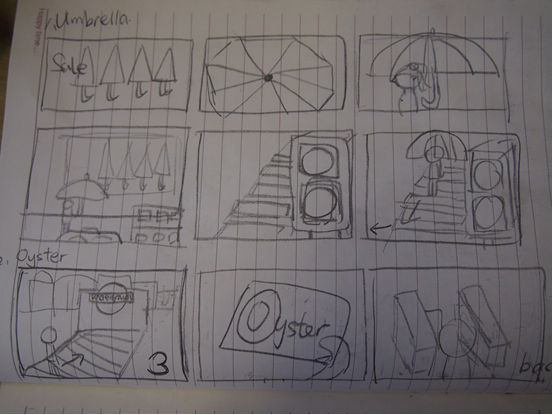
Before we embarked on the task, our dear teacher Deborah gave plenty of advice on the details. London on the Move traced “London” by each letter. As a result, we searched every element in the city that greatly represented London. In order to be efficient, we chose the suitable sites and predicted numerous obstacles we would face beforehand. In the end, we decided that “L” stood for the shape of the handle of the umbrella; “O” stood for the sign of the underground; “N” for newspaper; “D” for wildlife; another “O” for coffee and “N” for nationality. The video was finally presented in the form of a travelogue of a girl. When combined, L O N D O N constituted a whole picture of the city’s weather, transportation, journalism, ecological environment, leisure and racial diversity, which I thought, perfectly embodied the city’s features. During the workshop, it made me realize that what counted most was not the originality of the topic, but the novelty with which the ideas were presented. When the video was shown, a sense of success and satisfaction made it worth all the toil and trouble.
With the camera held in my hand, I lingered over the Thames until the last ray of sunlight disappeared from sight, trying to fully record the views. However, even the high-definition camera failed to do it, because the city of London required our hearts, rather than our eyes, to discover, to perceive and to savour its glamor.
21 days was far from enough to get the whole picture of London. But I really loved this program for the reason that it was a combination of in-class participation and out-class practice. The memory of this trip will never discolour with the charm of the city and its people.

Related Images: