Jeremy Paxman and buy pills levitra canada Bai Yansong spoke at the Future of Public Media workshop in Beijing

China Media Centre hosted leading TV stars as they shared insights on the opportunities for potential China-UK media partnerships

Jeremy Paxman (principal news and current affairs presenter, BBC), Wang Hui (Head of Communications, City of Beijing) in the chair, Bai Yansong (principal news and current affairs presenter, CCTV)

Jeremy Paxman and China’s leading current affairs presenter and writer Bai Yansong joined Paul Jackson and David Morgenstern, from the UK television industry, at the the Future of Public Media workshop organised by the China Media Centre of the University of Westminster and the Communications University of China. The event took place in Beijing, China, on 12 January 2012.

The full-day workshop explored common experiences and challenges facing public media organisations in China and the UK. Contributors came from academic, journalistic, policy and buy propecia online no prescription business backgrounds and investigated where common interests and potential partnerships can exist despite real differences in media systems, giving participants the chance to identify areas of common interest and build the foundations for future partnerships.


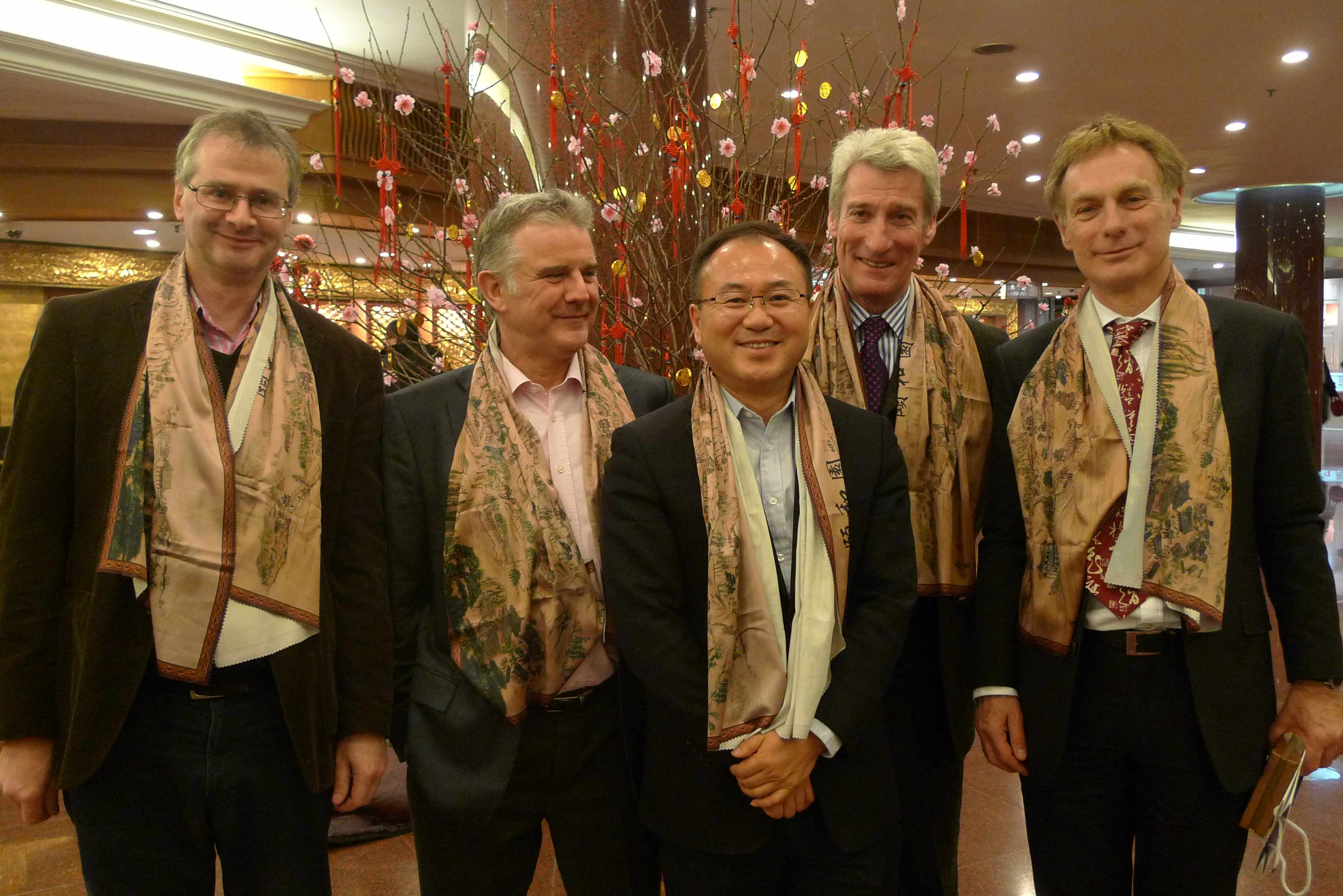
The four visiting British speakers at the conference, with the Conference Director, Professor Hu Zhengrong. (From left to right: David Morgenstern, Paul Jackson, Professor Hu, Jeremy Paxman and Professor Hugo de Burgh)

Key speakers attending the workshop included:

From the United Kingdom

  • Jeremy Paxman, the UK’s leading current affairs presenter.
  • Paul Jackson, an outstanding UK TV producer, former executive producer of BBC and ITV’s entertainment departments.
  • David Morgenstern, former director of BBC’s entertainment programme development department, currently Director of 10 Star company’s Programme R & D Department.
  • Prof Hugo de Burgh, Director of China Media Centre, University of Westminster.

From China:

  • Prof Hu Zhengrong, Deputy President of Communications University of China, Chairman of Chinese Media Research Association and the Honorary Doctor of the University of Westminster
  • Bai Yansong, China’s leading current affairs presenter and writer.
  • Yang Hua, Deputy Director of the CCTV News Centre
  • Zhang Haichao, Deputy General Manager of China International Television Corporation (CITVC)
  • Ren Xue’an, Deputy Director of CCTV Channel 1

Related Images:

Westminster communications research ‘world-leading’

rae2008

“Oxford may be rueing the day it decided to enter its researchers into the communication [category], the institution was beaten by… Westminster” – Times Higher Education Magazine

“A media studies department at a former polytechnic is among the top-rated academic centres in Britain in the latest official rankings of the quality of university research. Sixty per cent of the research published by the school of Media Arts and Design at Westminster University… was rated as “world-leading” by the Research Assessment Exercise”. – The Times

Communications, cultural and media studies research at the University of Westminster has been shown to be “world-leading” following the announcement today of the 2008 Research Assessment Exercise (RAE) results.

Researchers across a broad range of subjects at the University, which is a leading post-92 institution, have had their work shown to be of international quality in the latest assessment of UK university research activity. Nearly 80 per cent of Westminster’s research was found to be of a quality that is recognised internationally for its “originality, significance and generic kamagra online rigour”.

Art and Design, Architecture and the Built Environment, Geography and Environment Studies and Law also stood out for the international quality of the research.

Sally Feldman, dean of the University’s School of Media, Arts and Design, said: “This is a fantastic result and a reflection of the excellent scholarship, research and practice that characterises our work here at Westminster.”

The RAE, the first since 2001, highlights Westminster’s traditional strength across a broad range of research activity, said Vice-Chancellor Professor Geoffrey Petts.

“This result highlights that the University of Westminster is producing research of international quality across a broad range of subjects, with communications and cheap levitra 120 pills media studies world-leading in their work.

“We were assessed in 20 areas of work, which is an indication of the breadth of our work as well as the quality. It is also an indication that our research is being recognised for its potential to make a real difference in the world.

“I’m delighted Westminster was found to be so strong, especially as we are one of the group of universities created in 1992 that have traditionally received less funding than longer-established, research-led universities.”

The RAE, the first since 2001, saw 159 higher education institutions submitting their research to the Higher Education Funding Council for England for assessment. Over 200,000 individual pieces of research work were submitted.

—-From the website of University of Westminster.And here is a related article written in Chinese, from Chinese news media.

Related Images:

Two-Day Workshop on British Journalism at CCTV

cmc_ims_china_oct_09_1

China Central Television was the venue for a 2-day Workshop on British journalism organized by China Media Centre in October 2009. Speakers were Hugo de Burgh, CMC Director, Kevin Sutcliffe, C4’s Head of Current Affairs, Steve Hewlett, presenter of BBC’s The Media Show, Zhang Jie, Editor of CCTV’s News Investigation and Yang Rui, Presenter of CCTV’s Dialogue.

Related Images:

Parliamentary Seminar: ‘China and the New Green Deal’

‘China and the New Green Deal’, a China Media Centre conference, was held in Parliament in June 2009. It was the 6th conference on China held by CMC in Parliament.

WH2

A one-day CMC seminar was held in the Houses of Parliament to address the implications of China’s management of its environmental challenges for government policy and British business. It was hosted by the All Party Parliamentary Group on China and sponsored by Norton Rose. 170 people attended, from business, the policy world and media.

One of CMC’s research themes, along with regulation, journalism and innovation in the media, is the relationship between media and environment. This seminar is one of several initiatives connected with this theme, including a workshop at Caijing magazine in  Peking, producing a report on journalism and the environment for International Media Support and being knowledge partner for the October Wilton Park Conference on China’s environment.

This is a conference of the China Media Centre for the APPCG, with Knowledge Partner, Norton Rose LLP. With assistance from the Chinese Embassy and Chinadialogue http://www.chinadialogue.net/

Related Images:

CMC Connection: Boris Johnson

China Media Centre managed Boris Johnson’s first ever visit to China, to study higher education, just before he became Mayor of London

BJ9

Boris Johnson

The Mayor of London and former MP for Henley

伦敦市长Boris Johnson中国之行

BJ2In 2006 the CMC arranged Boris Johnson MP’s first trip to China, when he was Conservative Higher Education Spokesman. He and the Director of CMC travelled together to Shanghai and Peking where they were filmed by BBC Newsnight.

Photo: Boris Johnson in China

2006年,时任影子内阁高等教育部发言人、现任伦敦市长Boris Johnson 在中国传媒中心的安排下,与中心主任戴雨果教授一起,展开了他的首次中国之行;他们在上海和北京的行程由BBC的新闻之夜栏目(News Night)摄制成专题节目在黄金时间播出。

Steam-rollering into the future (Review of Hugo de Burgh’s China: Friend or Foe?)

Boris Johnson

Spectator, Wednesday, 28th June 2006

You’d better hurry if you want to see any of old Beijing. The lovely higgledy-piggledy brick hutongs are being blitzed in readiness for the 2008 Olympics. Even in the Hou Hai district, supposedly one of the last zones of ancient tranquillity, the imperial lakes are fringed with trashy bars and ugly black sound systems spilling on to the pavement.

Not far away tourists are taken to inspect the old codgers playing chess and mah-jong, surrounded by caged birds. The oldsters like to look at the birdies, the tourist will be told in a whisper. It was one of the simple pleasures that Mao destroyed. The dictator took it into his head that it was an act of bourgeois decadence even to admire birdsong or plumage. So children went around banging tin trays and the birds were driven from the trees.

BJ3

Photo: Boris Johnson joining in exercise at the Peking University.

As you look at these elderly victims of Maoist insanity, you can’t help wondering whether all the pundits are right about China. This is a place that still refuses to acknowledge the evil of Mao, and where his visage still hangs, fringed with tassels, from the rear-view mirror of buses. Are those mole-covered jowls really the face of the new China? Is it possible that this one-party state will achieve the kind of global dominance that some have recently forecast? In this clear, concise and fact-stuffed summary, Hugo de Burgh gives you all you need to make a pretty shrewd guess.

For those who think we’d all better take crash courses in Mandarin, the statistics are terrifying. China now consumes more red meat than any other country, and in the next five years will become a bigger trading nation than the US. Last year there were 50,000 miles of three-lane highway under construction, and new metro systems were being constructed in 26 cities, as well as 30 nuclear power stations. Shanghai has the world’s tallest hotel, the biggest shop, the highest television tower and the fastest train.

The Chinese middle class is exploding — I expect a thousand or so have been added to the ranks of the bourgeoisie since you began this article — and will number about 200 million this year. These are of course buying ever more cars, clothes and electrical appliances, and Goldman Sachs estimates that within ten years the Chinese will be buying 29 per cent of the world’s luxury goods. The Chinese are rapidly expanding their educational system, and they continue to excel in the crunchy subjects that British students find so off-putting. Almost 60 per cent of Chinese undergraduates study the sciences or engineering, compared to 36 per cent in the UK. How can they lose?

Well, as de Burgh points out, China is still a developing country, with per capita GDP of about $1,000 per year. We all have it in our heads that China is the world’s economic powerhouse; and yet the country is still afflicted by such poverty as to qualify for the world’s biggest slice of World Bank assistance. Never forget that the Chinese must feed a quarter of mankind with only 10 per cent of the world’s cultivable land, and with only 25 per cent of the global average per capita water supply.

That is why so much of China has been deforested or turned into a desert or a dump for nuclear waste, and the forced march to capitalism is producing anguish that can be every bit as painful as the Cultural Revolution. Villagers are killed if they protest against the expropriation of their land for development. In 2004 there were 74,000 protests of one kind or another, and yet there is no democratic outlet for these feelings.

Every university department has a party leader, every newspaper editor is under party control, and judicial decisions are subject to political review. Corruption is everywhere, tax is raised in a pretty arbitrary fashion, and a rickety social security system must cope with what promises to be the mother and father of all pensions crises — because each mother and father is only allowed one child, with the result that 27 per cent of the population will be over 60 by 2050.

Feed all these factors into your equation, and you begin to see why there is a case for a moderate sinoscepticism, a belief that all this hysteria about China may be slightly overdone. As Hugo de Burgh rightly concludes, there is no reason to fear China. She is no foe. He provides ample evidence that her march to global dominance will take much longer than some are currently predicting, and that in the meantime her integration to the capitalist system has been, on the whole, good for China and good for us. It’s Win Win, as some snazzy new Beijing nightclub has no doubt been auspiciously named.

Related Images: