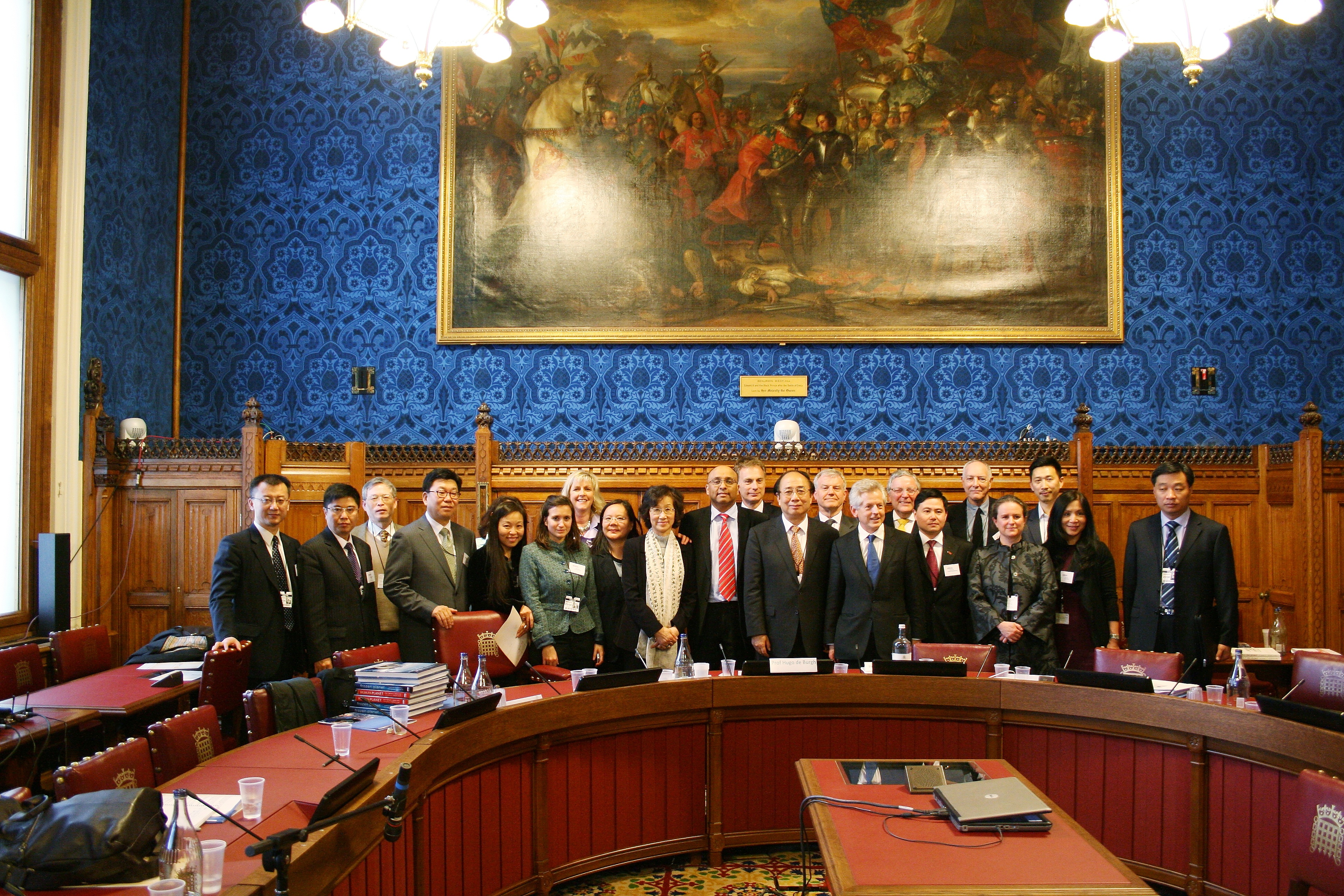
Soft Power and generisches viagra verkauf the Creative Industries: China and Britain

Palace of Westminster

Wednesday, 25 April 2012

The Chinese Government has just committed itself to using ‘culture’ and ‘public diplomacy’ as a driver to increase global understanding about China. This reflects concern that China must do better in promoting its culture at home and abroad; recognition of the part that the creative industries will play in boosting domestic demand; determination that ‘made in China’ be replaced by ‘created in China’.

To demonstrate that commitment, Vice-President Xi Jinping recently attended the signing of a major creative industry deal between Shanghai Media Group and the famous USA Dreamworks Group. Vice-President Xi’s attendance was a sign of the grasp of the importance of the creative industries at the highest level.

The implications for Britain of these culture industry initiatives by China:

The British Government wants many more business links between the UK and Chinese creative industries. The UK is recognised as being one of the most advanced creative industry centres in the world and Chinese companies know this. The UK has been a global leader in cultural industries and public diplomacy since the foundation of the British Council and the BBC in the 1930s. The government of both countries are determined to increase cooperation.

The Forum was opened by Minister Zhao Qizheng, Chairman of the Foreign Affairs Committee of the CPPCC, and spokesperson for the CPPCC. Until recently head of the State Council’s Information Office, he is acknowledged as the pioneer of China’s public diplomacy.

The Forum on April 25 at the Palace of Westminster drew UK attention to the recent policy changes in China, extrapolated on the implications for Britain, and provided a valuable occasion for our creative businesses to identify opportunities, and for ministers and acheter du diflucan sans ordonnance parliamentarians to understand the potential of China partnerships.

FINAL Soft Power and Creative Industries Programme

Related Images:

China Media Centre 2012 Spring Seminar 4

China Media Centre 2012 Spring Seminar

Photojournalism in China 

Speaker:  AN Guanxi,   XIANG Mei

Date: Thursday, 29th March 2012

Time: 11am-1pm

Venue: A 7.3

Chair: Guo Dawei

OPEN TO ALL


Mr. AN Guanxi is now a Visiting Scholar at the China Media Centre, University of Westminster. He also joined University Missouri in the US in 2010 as a visiting scholar. Mr. An was the director of Photo Department in Oriental Morning Post based in Shanghai for more than 5 years. He obtained his Master degree from the first Master Course organized for Chinese photojournalists to learn digital media in 2008.

In this seminar, Mr. An will introduce photojournalism in China; the requirements of photojournalists, agenda setting and the trend of photojournalism.


Mrs. XIANG Mei has rich experience working for the Olympic games as media operator. Before join Xinhua News Agency as photojournalist and editor in 2009, she worked for the Beijing Organizing Committee for the Games of 29th Olympiad as a project manager in Photo Services of Media Operations. In 2011, Mrs. XIANG moved to London. She is now studying Media Management at University of Westminster, while working for Xinhua News agency’s London bureau as well as working for 2012 London Olympic as media operator.

She will talk through her experiences as a photojournalist, editor and media operator during big events.


More about China Media Centre and seminars see https://chinamediacentre.org/

If you have any inquiry about CMC events, please contact Miao Mi at m.mi@my.westminster.ac.uk

Related Images:

China: Literature and political reform

Today it was reported that Wen Jiabao, once again, has called for faster political reform at the end of the National Peoples’ Congress. There have been many political reforms over the past 30 years, to say nothing of social changes that have made the country more open. So what’s he worried about? Well, since he warned that he thought that turmoil of the order of the Cultural Revolution might be on the cards if China does not deal with this matter, he seems to be saying that the gulf between the power holders and the powerless is too great. That cataclysm was to a large extent about the fact that a greedy minority had got its hands on all the power and cialis sur ordonnance autriche all the food and many people bitterly resented it. Sadly for the victims, the brutality was often deflected onto relatively powerless people, such as intellectuals on the survivors of the slaughter of the ‘bourgeoisie’ in the 1950s.

But today the situation is not the same. Vast numbers of people are much better off than before and the country as a whole is succeeding in improving life in every facet, which was definitely not the case before the 1980s.  Little by little officials are subject to scrutiny and procedures – from peer review to elections to the Freedom of Information Law – that oblige them to be more accountable. And New Media has frightened the baddies and encouraged good behaviour.

What Wen is probably worried about are two great gulfs; first that between the highly educated, public spirited and competent central government policy world and the local officials with their immense power and their inclination, as always in Chinese history, to enrich themselves; then there’s the gulf between the latter and ordinary people, who find their efforts to run their businesses stymied by corruption and political obstruction. The state is both catalyst of change but also able to stifle it. The Party interferes in everything too, from investment decisions to court cases, ostensibly on ideological grounds.

It’s not only the Chinese Prime Minister who is concerned. Our famous commentators, from Neil Ferguson to Peter Hitchens, Will Hutton to Jeremy Paxman all opine. Their underlying themes, it seems to me, are twofold: how will China use its power in the emerging world order in which the USA is not the ‘predominant hegemon’ to use a Chinese expression, and whether the Chinese political system is fit for purpose, or whether it will collapse under pressure from a dissatisfied citizenry and because of its inability to control corruption.

Martin Jacques in his thought provoking WHEN CHINA RULES THE WORLD has made a good start on thinking through the first issue, but on the second, raised onto the domestic agenda again yesterday by Wen Jiabao, our great commentators are not very satisfying not only because they hold to the ideological position that the only workable government model is that of Anglo-America, but also because it’s really hard to know what’s going on.

Among a few others, the American academic Shambaugh writes very well on Chinese government, McGregor has done a good book on The Party and Kerry Brown at Chatham House has published a stimulating book on elections in China,Ballot Box China. They all help scope the field and they all tell us about the brilliant people at the top.

But the book that offers a deep insight into Chinese government at the local level – for me, at any rate – is a novel. A Civil Service Diary by Mouse tells the story of a young graduate in his first years as the lowest of all civil servants in a poor rural parish. Badly treated by his superiors because he has no contacts, he struggles to serve the peasants in his charge by getting built the road which will link them to civilization, allow them to sell their produce, make enterprise worthwhile and raise their standard of living.

Every stage of his battle with bureaucracy, his search for funding, his efforts to persuade villagers to give up land and contribute labour, his persuasion of the planning department to hand over the specifications, his need to grease palms to get permissions – every one is there. The detail is riveting because it all rings true. Young Mr Hou is a very competent operator in a world in which interpersonal relations, the ability to build networks and the guile to avoid corruption and its attendant dangers are vital skills.

The novel hides nothing. There are officials who have the youngest and newest girls at the local brothel reserved for them; there are the fund managers who demand payoffs for releasing mortgages and grants; at one point a government investigation team beats up Mr Hou and tortures him with sleep and food deprivation.

But at the same time there are able and decent people fighting that China may succeed and people get opportunities and material conditions that their parents could not dream of. You realise that what we call corruption can exist side by side with public spiritedness and dedication, sometimes in the same persons.

At the end of volume 1 Hou is elected to an important position in the teeth of the establishment, which does everything it can, bar breaking the law, to get his name expunged from the candidates’ list. Until Hou’s local colleagues submitted his name as a candidate with the requisite number of local signatures, no—one had ever stood against the official list. The local Party Secretary is incensed and his machinations as he tries to find ways of annulling or undermining the vote are comic; the shame of the official candidate who, in the elections, is knocked out by Hou, is awful, because we know that the ambitious competitor has built his hopes of future job security, achievement, marriage and reputation on winning.

There are 9 more volumes to go and I am going to read every one of them.

Today’s Chinese literary renaissance is like nothing so much as that of Victorian England. On this, I will keep you posted.

http://www.cps.org.uk/blog/q/date/2012/03/14/china-literature-and-political-reform/

Related Images:

China Media Centre 2010 Spring Seminar Series 3

CHINA: SOCIAL MEDIA AND POLITICAL PARTICIPATION

Speaker: Dr. Bingchun Meng

Date: Thursday 8th March, 2012

Time: 2-3.30pm

Venue: A6.5, Maria Hewlett Building (A Block), Harrow Campus

Chair: Prof Hugo de Burgh

OPEN TO ALL

In this presentation, Dr Bingchun Meng will first lay out some of the theoretical debates as well as methodological challenges regarding the research of mediated citizenship. She will then draw upon my two recently completely projects, one on online spoofs and another on a peer production community on the Chinese Internet, to offer some empirical materials for reflecting on the issue of mediated citizenship. Dr Meng will conclude with a few thoughts on future research agenda.

Biography:

Bingchun Meng is a Lecturer in the department of Media and Communications at London School of Economics and Political Science. Her main research interests lie in communication governance and media production, both of which are examined in the context of globalization and technological shifts. There are three strands in this research: 1) What are the institutional responses to the challenges brought by new communication practices such as disturbance to political control and subversion of the conventional business model; what are some wider ramifications of such responses? 2) How have the institutional arrangements of media production changed in response to the local and global conditions and how the change affects the content being produced. 3) Media production at the grass-root level. How citizens exploit the opportunities afforded by digital technologies to expand their cultural and political participation, which, in different social contexts, may be constrained. These lines of research are connected by a general inquiry into the power dynamics operating at the macro- and micro-levels in communication networks.

Before joining LSE, Dr Bingchun Meng was a post-doc fellow at the Annenberg School for Communication, University of Pennsylvania, where she worked at the Centre for Global Communication Studies and also taught courses on Chinese media. She obtained her PhD in Mass Communication from the Pennsylvania State University.

If you have any queries about CMC events, please contact Miao Mi at m.mi@my.westminster.ac.uk

Related Images:

China Media Centre 2012 Spring Seminar Series 2

‘EVERYTHING DEPENDS ON LOVE’:

CHINESE CHRISTIANITY AND THE PARTY

Speaker: Dr GerdaWielander
Date: Monday 5th March
Time: 2-4pm
Venue: A 6.8 Maria Hewlett Building (A Block) Harrow Campus
Chair: Prof Hugo de Burgh
OPEN TO ALL

This talk asks the question what influence Christian values have had on social and political values in post-socialist China. Christianity, understood as an ideological source of social and political values, informs both official ideology and ‘dissident’ ideology, albeit in different ways and to a different extent, and is an increasingly accepted source of social moral and ethics in contemporary China. I argue that while we tend to think of China as an atheist, secular state, it is in fact vital to understand the importance religion plays in the state’s response to emerging new values in society without giving ground in terms of a more democratic system.

Biography:

Gerda Wielander’s research interest lies in contemporary China’s social and political development. Most recently she has been interested in the way Christian belief is influencing and shaping political discourse in contemporary China. She has published several articles in this field and has been awarded an AHRC Fellowship in 2012 to complete her book on Christian values in Communist China (to be published with Routledge in 2013).

GerdaWielander was educated in Vienna and Beijing. She obtained an M.A. in Chinese Studies in 1990 with a dissertation on Liang Qichao’s historiography, including a first translation into German of Liang’s “XinShixue” (New Historiography). Her PhD (1995) investigated the Malaysian Chinese evaluation of China’s Democracy Movement (1976-1989) as expressed in the region’s vibrant Chinese press.

Gerda is Principal Lecturer in Chinese Studies and Director of the Undergraduate Languages Programme in the School of Social Sciences, Humanities and Languages. She has taught at a number of British universities including SOAS and Cambridge before coming to Westminster in a full-time capacity.

More about China Media Centre and seminars see https://chinamediacentre.org.

If you have any queries about CMC events, please contact Miao Mi at m.mi@my.westminster.ac.uk

Related Images: