Media Digest, May 14-20, 2010

Headlines

  • China issues white paper on Internet policy
  • Govt shuts down Internet bars before entrance exam
  • China Mobile to invest in People’s Daily Online
  • Welcome to the i-Party
  • Dating show contestant banned for sexy modeling?
  • World Cup poses a challenge for studios (world)
  • Games are going 3D in wake of Hollywood’s success (world)

China issues white paper on Internet policy

The Chinese government Tuesday published a white paper on its Internet policy, stressing the guarantee of citizens’ freedom of speech on the Internet and viagra no prescription more intensive application of it. The white paper, released by the State Council Information Office, introduced facts of the development and use of the Internet in China, and elaborated on the country’s basic policies on the Internet.

The Chinese government actively advocates and supports the development and application of the Internet across the country, it said, stressing the government’s basic Internet policy: active use, scientific development, law-based administration and ensured security. By the end of 2009 the number of netizens in China had reached 384 million, 618 times that of 1997 with an annual increase of 31.95 million users. The Internet had reached 28.9 percent of the total population by the end of 2009, higher than the world average. Its accessibility will be raised to 45 percent of the population in the coming five years, it said. There were 3.23 million websites running in China last year, which was 2,152 times that of 1997.

Of all the netizens, 346 million used broadband and 233 million used mobile phones to access the Internet. They had moved on from dialing the access numbers to broadband and mobile phones. “These statistics make China among the top of the developing countries in developing and popularizing the Internet,” the paper said. The Internet has become an engine promoting the economic development of China. Information technology (IT) including the Internet and its industry has made significant contributions to the rapid growth of the Chinese economy, it said. In the past 16 years, the average growth rate of the added value of Chinese IT industry grew at over 26.6 percent annually, with its proportion in the national economy increasing from less than 1 percent to 10 percent, according to the paper. Meanwhile, the Internet has become an indispensable tool in people’s every-day life, it said.

According to a sample survey, in 2009 alone, about 230 million people in China gathered information using search engines, and 240 million communicated through real-time telecommunications devices. Also, 46 million Chinese people received education with the help of the Internet, 35 million conducted securities trading on the Internet, 15 million sought jobs through the Internet, and 14 million arranged trips via the Internet. The Chinese government is determined to further promote Internet development and application so that more people can benefit from the Internet, the paper said. “Chinese citizens fully enjoy freedom of speech on the Internet,” it said, adding that China’s websites attach great importance to providing netizens with opinion expression services. Over 80 percent of China’s websites provided electronic bulletin service. And there are over 1 million BBSs and some 220 million bloggers in China. According to a sample survey, over 66 percent of Chinese netizens frequently place postings to discuss various topics, and to fully express their opinions and represent their interests. “The Internet’s role in supervision is given full play,” the paper said.

Over the past few years, a great number of the problems reported through the Internet have been resolved. In order to facilitate the public’s reporting of corrupt and buy sale viagra 10mg degenerate officials and suchlike, the central discipline inspection and supervision authorities, the Supreme People’s Court, the Supreme People’s Procuratorate and other relevant bodies have set up informant websites. The informant website of the Communist Party of China (CPC) Central Commission for Discipline Inspection and the Ministry of Supervision, and the website of the National Bureau of Corruption Prevention are playing an important role in preventing and punishing corruption and degeneration among officials. A sample survey found that over 60 percent of netizens had a positive opinion of the fact that the government gives wide scope to the Internet’s role in supervision, and considered it a manifestation of China’s socialist democracy and cialis erwerben progress, the paper said. “The Chinese government believes that the Internet is an important infrastructure facility for the nation. Within Chinese territory the Internet is under the jurisdiction of Chinese sovereignty,” it said, stressing that the Internet sovereignty of China should be respected and protected.

According to the paper, computer crimes in China have been on the increase in recent years.

Public security departments dealt with 142 computer crime cases in 1998, 29,000 in 2007, 35,000 in 2008 and 48,000 in 2009. “China is one of the countries suffering most from hacking,” it said.

According to incomplete statistics, more than one million IP addresses in China were controlled from overseas in 2009, 42,000 websites were distorted by hackers. Besides, 18 million Chinese computers are infected by the Conficker virus every month, about 30 percent of the computers infected globally. National situations and cultural traditions differ among countries, and so concern about Internet security also differs, the paper said. “Concerns about Internet security of different countries should be fully respected,” it said.

The Chinese government will constantly adjust relevant policies to better match the inherent law and the objective requirements of the development and administration of the Internet, according to the paper. The 31-page document is divided into six sections: Endeavors to Spur the Development and Application of the Internet, Promoting the Extensive Use of the Internet, Guaranteeing Citizens’ Freedom of Speech on the Internet, Basic Principles and Practices of Internet Administration, Protecting Internet Security, and Active International Exchanges and Cooperation. (Xinhua 08/06/2010)

Govt shuts down Internet bars before entrance exam

The government of Linchuan district in Fuzhou, Jiangxi province, has temporarily closed down all Internet cafes in its jurisdiction in a bid to prevent students from getting distracted ahead of the college entrance examination.

The move implements a document issued by the district’s cultural affairs bureau last year, which stipulates that the business of Internet bars should be suspended during the college entrance exam, which takes place on June 7 and 8 every year, the Jiangxi-based New Legal News reported. Some local Internet cafe owners have been asked to shut down for nearly a month, the report said. A local cafe owner complained on tianya.cn, the country’s biggest online forum: “I will lose 10,000 yuan ($1,460) if my business is suspended for a month, when the cost of running the shop remains the same.” An insider at the Linchuan telecommunications office said Internet bar owners were notified before their web connections were snapped on May 10. A notice from the district government said the compulsory suspension of Internet cafs between May 10 and June 9 was to “protect Linchuan’s image as an education-developed region”.

Linchuan district, known for its outstanding educational tradition, attracts a lot of students from all over the province to go to school there. But Xiong Guanghui, head of Linchuan Internet Bars Plural Executive, denied there was any enforced action to close down Internet cafes. “We’re not authorized to shut down the cafes. Most of the owners suspended their business voluntarily,” he told China Daily on Monday. According to local media reports, the culture affairs bureau of Linchuan has been forcing Internet bar owners to sign an agreement every year since 2005, which claims they voluntarily agree to shut down their business temporarily. Residents of Lincheng county in Shanxi province are faced with a similar situation. Online complaints report that cables in all Internet bars in the county have been unplugged.

Unlike in Linchuan, this is the first time in Lincheng that Internet bars have been shut down ahead of the college entrance exam, said the local authority. Lincheng residents argue that students can also get distracted by karaoke bars, which remain open. A Lincheng government official surnamed He said he was not aware of the issue and amoxil ohne rezept refused comment. Although the suspension has triggered some criticism, parents whose children will be sitting for the coming exam are happy with the move. A Fuzhou resident surnamed Wang said he’s always worried his son will be distracted by Internet bars, and considers the government’s move “appropriate and effective”. Yi Shenghua, a lawyer from Beijing Yingke Law Firm, said forcing Internet cafs to shut down is against the law. “Government action should be restricted by law. It is illegal for the government to force the caf owners to suspend business without reaching agreements beforehand.” (China Daily 01/06/2010)

China Mobile to invest in People’s Daily Online

China Mobile will invest 20 million yuan ($2.93 million) to become a strategic investor in the People’s Daily Online, a government-backed online news portal planning a mainland listing, the Wen Wei Po reported on Thursday, citing mainland media reports.

China Mobile spokeswoman Rainie Lei told Reuters that the parent company had not heard of the investment plan, but an official announcement would be made in a timely manner if there was any major investment or acquisition. The People’s Daily Online may restructure its shareholding and speed up its listing process, the Chinese newspaper said, citing sources. People’s Daily Online President He Jiazheng declined to comment on the report but said the company was focusing on restructuring, the newspaper said.

Beijing had selected a number of state-backed online news platforms including Xinhuanet and Eastday.com to list shares to reduce government’s financial burden and to enhance competitiveness, the newspaper said. At least two online news platforms could issue A shares before the end of the year, the paper added. (Reuters 10/06/2010

Welcome to the i-Party

The Communication University of China’s branch of the Communist Party of China has launched a party newspaper for mobile phones. Intended as a way to “effectively harness the university’s professional strengths in the media realm to explore new avenues of party-building work,” the new paper was given a trial publication in 2009 before its formal launch at the beginning of this year.

In Chinese, the paper’s name is fairly straightforward: CUC Institutional Mobile Party Newspaper (中传机关手机党报). In English, the paper is called by the trend-chasing name i-Party. According to the university’s news portal, this name carries multiple levels of meaning. An explanation of “i-Party”: The letter “I” means “me” in English. It is the first letter of words such as “Internet” and “Information,” one of the symbols of the Information Age, a symbol of “me-media” in the New Media era, and is a sound-alike for “love” (爱). The lower-case “i” says that I am a member of the party, and the capitalized “Party” refers to the Communist Party of China in particular. “i-Party” means the party in the age of new media, that our party is keeping pace with the time. It also means that I and the Party are inseparable. Finally, it expresses love for the Party. Twelve issues have been published to date. A total of 3,600 MMS messages have been distributed to an audience that includes not just party members at the school, but students, teachers, and media professionals as well.
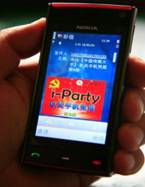
clip_image002The reports on i-Party do not claim that it is the first party newspaper prepared especially for mobile phones. But I’d be willing to bet that it’s the first to put a heart atop an “i” in its nameplate. (ww.Danwei.org 08/06/2010)

Dating show contestant banned for sexy modeling?

If You Are The One (非城勿扰), a dating program on Jiangsu TV, has produced some dodgy contestants, some of whom admitted afterward to pretending on be outrageous characters the show. Now, it is rumored that a Beijing model, Ma Nuo (马诺), who has modeled for Gome Electrical Appliances and for magazines such as Cosmopolitan, has come under fire for her remarks about only dating super rich guys. The rumor making the rounds is that SARFT has banned her appearances on future reality TV shows.

Ma Nuo’s famously said that she’d rather weep in a BMW than go for a ride on the back of a poor contestant’s bicycle. Then - shock! horror! - it emerged yesterday that a set of her ‘revealing’ lingerie photos has been found! The headline precludes that the two (getting banned and the sexy photos) could be related.

The proposed report is from Qingdao news net, via cqnews.com:

Ma Nuo became the center of attention after saying on If   You Are The One that she would rather ‘sit and cry in a BMW’ (宁愿坐在宝马车中哭泣). These sharp words made her more popular than ever, and after she left If You Are The One many TV stations fought after her, including Guizhou TV and Zhejiang TV. It is rumored around town that Anhui TV is proposing a rate usually given to a B-List actress to sign up Ma Nuo, and she is indeed a guest on the new version of Sunday Best (周日我最大) and its dating segment, It Was You (缘来是你). The first series of the successful new version of Sunday Best, together with Ma Nuo’s participation, saw viewing rates and click-through rates on the Internet go up steadily. Just as the production team were making the second series in secret, they were told that they had to halt Ma Nuo’s participation in the production of the programs.

It was also heard that the production crew of Zhejiang TV’s Singing and Dancing (越跳越美丽) will pause the making of episodes that shows Ma Nuo participating. Both Ma Nuo and her assistant claim that they haven’t heard about this, and that whatever comes next, they will arrange their

Sunday Best The most amusing part of this news report, however, is the headline, which reads: “Again Ma Nuo exposes large quantity of pictures taken in her underwear, rumored ban from SARFT” (马诺又曝海量喷血内衣照 传已遭广电总局封杀) The accompanying pictures to the article has no less than 30 pictures of Ma Nuo in underwear. Those who are familiar with online shopping for lingerie know that these are a series of photos she took for Lamiu, a Tokyo brand selling online in the mainland. The first one displayed on the Qingdao news net article is a shot of a Lamiu bra used in plunging dresses often seen on celebrities. Every subsequent photo comes from the Lamiu website, and the variations of

(Anhui TV’s Sunday Best program logo)

her turning around, her back, and the different sets of underwear modeled, which can hardly be constituted as clandestine photos, are reposted on the news website.

IMAG1242712101991372

(Zhejiang TV’s Singing and Dancing program logo)

(ww.Danwei.org 08/06/2010)

World Cup poses a challenge for studios

The greatest show on turf, the World Cup soccer tournament, kicks off Friday in South Africa for a month of sporting highs and lows. And for recession-dazed Europeans, the event is a welcome dose of free entertainment as government austerity measures sweep across the continent.

The organizers earn more than $3.4 billion from rights fees and sponsorships, while the billions of viewers will boost networks’ advertising revenues. Commercial channel ITV, which is sharing World Cup rights in Britain with the BBC, is forecasting a 25% rise in advertising revenue thanks to the tournament — more if England’s squad does well. The 25% revenue hike could amount to a $100 million windfall. While small-screen providers are caught up in World Cup fever, the U.S. studios view the event as a monthlong headache. The first two weeks of the tournament are the worst, since there will be matches at lunchtime, the afternoon and in primetime across Europe. “It’s a massive distraction, and if the country in question is playing, the business (in theaters) drops like a stone,” said Duncan Clark, Universal Pictures International’s executive vp distribution. “Counterprogramming is something we’ve done in the past because there are four or five other days between the games played. So you can do good business on those days if you’re prepared to accept a couple of down days.”

Female- and family-focused pictures are in favor as a Cup alternative. Disney opens the Kristen Bell romantic comedy “When in Rome” in Italy, Germany, Spain and the Netherlands in the first week of the tournament. (The picture earned just $33 million in North America after opening in January.) Paramount is offering “She’s Out Of My League” (released three months ago in North America to $32 million) in the major territories, including the U.K., Italy and France, and penciling in the European rollout of “Shrek Forever After” during the World Cup‘s quarterfinal stage. “It’s a tough one,” said Andrew Cripps, president of the studio’s international arm. “We certainly felt there’s an opportunity for a family-orientated film to get an audience, but there’s no question it’s a big challenge.” Fox is the only studio taking the Cup head-on by opening its male-oriented action tentpole “The A-Team” this weekend in 34 territories, including markets with teams in the tournament such as the U.K., Australia, Brazil, the Netherlands and Mexico.

To combat the drought in moviegoing, many theater owners have chosen to embrace the beautiful game and will screen matches in theaters. Countries such as Spain and Italy will offer 3D screenings of the games. International distributors will face another challenge after the July 11 World Cup final. The pack of top titles crammed into the first post-soccer weeks, including “The Twilight Saga: Eclipse” and “Toy Story 3,” risk creating a blockbuster bottleneck. (Reuters 11/06/2010)

Games are going 3D in wake of Hollywood’s success

With 3D movies boosting both audience experiences and box office coffers, videogame publishers are following Hollywood’s lead and developing 3D games to immerse players more into virtual worlds.

Game makers like Sony Computer Entertainment, Nintendo, Electronic Arts, Capcom, Take-Two Interactive, and Warner Bros. Interactive Entertainment will unveil stereoscopic 3D video games at the E3 Expo in Los Angeles next week where over 45,000 game industry professionals check out the big titles of the next year. “Gamers are the early adopters and once they experience games in 3D, they’re not going to want to go back,” said Oscar-winning producer Jon Landau, who worked with Ubisoft last year to release the first 3D console video game, “James Cameron’s Avatar.” Sony Computer Entertainment will publicly unveil its first big 3D PlayStation 3 video game, developer Guerilla Games’ Killzone 3, at E3 which is running from June 15-17. The latest installment in the bestselling science fiction shooter franchise has been developed from the ground up to take advantage of stereo 3D.

Developer Polyphony Digital is enhancing the upcoming “Gran Turismo 5” PS3 racing game into a 3D experience, which will also be on display at Sony’s booth. “3D is the natural progression of video game technology and it allows us to replicate the experience you have when driving a real car,” said Taku Imasaki, producer of “Gran Turismo 5,” Sony Computer Entertainment America. Anyone who owns a PS3 can download a free firmware upgrade to turn the game console into a 3D machine that will play both 3D video games and Blu-ray 3D movies. “When you play a (2D) video game today, it’s almost like you’re playing with one eye closed,” said David Coombes, platform research manager, Sony Computer Entertainment America.

Sony is practicing synergy across its electronics, video game and home entertainment divisions to get 3D into homes. Consumers who purchase any of the new 3D Bravia TVs, which will be released in the United States next month, will get a copy of Sony Pictures Home Entertainment’s “Cloudy with a Chance of Meatballs” Blu-ray 3D and a voucher for four PS3 games. Gamers can log onto the PlayStation Network Store and download 3D demos of “PAIN” and “MotorStorm: Pacific Rift” and full 3D versions of “WipEout HD” and “Super StarDust HD.” “3D gaming is an immersive experience that adds a new dimension to home entertainment and will help drive adoption of new 3D HDTVs like Sony’s Bravia,” said Mike Abary, senior vice president of Sony’s televisions and home audio video business.

Michael Cai, vice president of research at Interpret, authored a new report called “3D State of Union: Are Consumers Ready?” He found that 3D TV purchase interest among current PS3 and Xbox 360 owners doubles that of the general population. Overall, 13 percent of American households are interested in purchasing a 3D TV over the next 12 months. “Based on consumer data, we anticipate more than 4 million 3D TV sets to be sold in the United States in the next 12 months,” said Cai. When it comes to video games, Cai said big titles in the first-person shooter, racing, and action/adventure genres will drive consumer adoption of 3D gaming, as these genres will provide the most significant enhancements to the gaming experience.

Nintendo will make a big splash at E3 with the unveiling of its Nintendo 3DS portable game device, which will feature autostereoscopic 3D technology that allows viewers to experience 3D games without wearing special glasses. Thanks to its broad spectrum of gamers across all demographics, Cai found that 27 percent of male gamers and 19 percent of female gamers plan on buying a Nintendo 3DS when it comes out this fall. An additional 35 percent of male gamers and 37 percent of female gamers may buy the gaming device.

NVIDIA is another company that has been pushing stereo 3D experiences for PC games through its GeForce 3D Vision technology. The introduction of 3D laptops from companies like Asus and Toshiba has made it easier for gamers to get a 3D experience on the go. NVIDIA’s 3DTV Play, which allows 3D PC content to play on any 3D TV, has helped encourage more game developers to add stereo 3D to their games. “3D is becoming increasingly important in the gaming world, with 3D compatibility a function of all leading titles, and as we move forward content will align with a developing base of 3D-enabled consumer electronics devices,” said Patrik Pfandler, senior market analyst, Futuresource Consulting. (Reuters 10/06/2010)

Edit by Jackie Fang YIN

Related Images:

Media Digest, May 7-13, 2010

Headlines

  • Chinese media outlets look set to make IPOs
  • China’s culture industry hit 800 billion yuan in 2009
  • Integration plan promotes radio, TV and film
  • Time to review code on political advertising
  • The future of television seen through rose-colored glasses
  • Television revolution redux
  • 20 jailed for CCTV tower blaze
  • CABLESHOW-Cable warns programmers on rush to Web (World)
  • Networks unlikely to profit from World Cup (world)

Chinese media outlets look set to make IPOs

Ten Chinese websites are to be listed in the domestic A-share stock market, according to media reports, with Shanghai-based eastday.com hoping to become the first to launch initial public offerings (IPO), analysts said. They include websites of China’s State broadcaster China Central Television, Xinhua News Agency, People’s Daily, Beijing-based qianlong.com, Tianjin-based enorth.com.cn, Shandong-based dzwww.com, Shanghai-based eastday.com and other local online news websites, Shanghai Securities News reported on Sunday, citing an anonymous source. “The Publicity Department of the Communist Party of China Central Committee and the China Securities Regulatory Commission (CSRC) are actively pushing the listing of these websites and, at least, one or two websites will make it this year,” the source was quoted as saying. China Daily contacted the CSRC and a spokesperson did not deny the report, but declined to divulge any further details or to comment on the situation,

Xu Yaowen, an analyst with China Galaxy Securities, said that eastday.com has completed share-holding reform and could be the first of the websites to be listed in the A-share market.

“As emerging media outlets, websites will create a breakthrough in the cultural development of China,” said Zhang Xiaoming, a researcher with the Chinese Academy of Social Sciences. With accelerated technological change, the new media are gaining increasing influence, he said.

However, analysts pointed out, as some of them belong to government agencies and are not wholly market oriented, they may not be able to receive listing in the capital market like free-market companies. Some commentators also oppose government-supported listing of media websites. Fan Feng, a Beijing-based commentator, said investor interest could be jeopardized, since the performance of these websites is not sound enough to bring the revenue expected by investors. Commercial portals, such as sina.com and sohu.com, have been listed in the overseas market. “The upshot is that competitive websites will receive listing overseas, while domestic listing is encouraged for second-class ones. Then how can domestic investors’ interest be protected?” Fang asked. (China Daily 05/10/2010 page2)

China‘s culture industry hit 800 billion yuan in 2009

The scale of China’s culture industry in the global market hit 800 billion yuan ($117.18 billion) in 2009, according to a report jointly issued by the culture research center of Chinese Academy of Social Sciences (CASS) and Social Sciences Academic Press, chinanews.com reported. The report says the culture industry has become a strategic industry for China.

According to the report, new media has emerged as a major force in the culture industry. Fueled by 3G technology, the number of mobile netizens rose to 233 million in 2009, amounting to 60.8 percent of the total, the website said. The film industry is also poised to grow, according to the report. China produced 456 feature films last year, ranking third in the word, following India and the US, according to the news report. The report also shows that the country’s cable television users increased by 6.1 percent year-on-year to 174 million in 2009, with nearly 62 million of them being digital television users, a 36.94 percent increase from the previous year The domestic market for artistic performance kept a strong momentum last year, and the supply and demand of performances have been growing, the website reported.

According to statistics from the General Administration of Press and Publication, China’s press and publication industry defied the financial crisis and kept growing at a stable rate throughout 2008. The report forecasts that the industry will reform deeper and finalize the systematization of its commercial operations this year, the website reported. (07/50/2010 Chinadaily.com.cn)

Integration plan promotes radio, TV and film

Revenue generated from China’s radio and television products are predicted for the first time to hit 200 billion yuan ($29.29 billion), and as domestic box office sales accumulated 3 billion yuan in the first quarter of 2010, the total revenue from China’s film products this year may surpass 10 billion yuan, the Shanghai Securities News reported. Pang Jingjun, deputy director of the development research center with SARFT, said at a press conference that revenue from China’s television advertising and new media would continue to grow amid the financial crisis.

The Report on Development of China’s Radio, Film and Television 2010 issued by the State Administration of Radio, Film and Television (SARFT) on Tuesday said the tri-networks integration plan has promoted the development of radio, film and television industries and new media industries in China even during the financial crisis.

In 2009, the total revenue from China’s radio, film and TV industries reached 195.95 billion yuan, up 17.53 percent from the previous year. Among which, 185.29 billion yuan was generated by radio and TV industries, an increase of 17.06 percent from a year earlier. The revenue included financial subsidies from the government, according to the report. Pang said the film industry revenue surged 26.47 percent year-on-year to reach 10.67 billion yuan and box office sales reached 6.21 billion yuan, up over 25 percent continuously for the sixth year. He also said State-owned traditional media and commercial websites began cooperation, and a standardized pattern where the Internet provides audio-visual programs was established. (19/50/2010 Chinadaily.com.cn)

Time to review code on political advertising

Vice Chairman of the Democratic Party Lau Wai-hing and five young politicians of the Democratic Alliance for the Betterment and Progress of Hong Kong (DAB) coincidentally paid Commercial Radio for a program to give them time to promote their activities. This triggered a debate in Hong Kong as to whether Commercial Radio shall be allowed to broadcast paid political programs. Whether the propaganda advanced by the two was political advertising and whether it would create a disadvantage for political groups without strong financial support are indeed the core issues of the debate.

According to Section 28 of the Radio Code of Practice on Advertising Standards (Code) formulated by the Broadcasting Authority: “No advertisement of a political nature shall be broadcast except with the prior approval of the Broadcasting Authority.” There is, however, a grey area as to the definition of “advertisement of a political nature”. There are three aspects to consider: “an advertisement of a political nature by a political organization”, “an advertisement of non-political nature by a political organization”, and “an advertisement of a political nature by a non-political organization”. The first case is simple. It obviously goes against the Code, but the second and third situations are not as clear. For example, the DAB’s program intended to raise concern for young night drifters is of the second category. The content of the program itself is not political in nature, but the program hosts and sponsor are all members of a political organization.

After this incident, it is time for the government to review the Code. For example, the government should give a clearer definition to the meaning of “political advertisement”. There is also room to review the existing restrictions on political advertisement. As the political system in Hong Kong is opening up, there is stronger need for adverting by political personalities.

The Hong Kong government should not evade the issue or ignore that demand but there must be the precondition that the message shall be transmitted fairly, justly and openly under proper regulation so as to prevent a monopoly of radio or television channels by a very small number of people.

The following issues may be considered in regulating electronic media’s broadcasting of political advertisements and acceptance of political parties’ sponsorship of programs. First, it has to restrict the time for the broadcast (for example, prime-time broadcasting of such advertisements shall not be allowed); second, there shall be a restriction on the length and duration of such broadcasting; third, there shall be a restriction for the percentage and the proportion of political advertising in comparison to all other programing on radio or television stations; fourth, there shall be a standard rate to ensure different parties or people pay the same charges on such programming. Of course, the above are only some issues, among many, for public discussion.

In line with the review of the Code, it is also to be noted that many of the restrictions in the Election Ordinance (EO) are artificially designed to create many unnecessary obstacles for election campaigners. Many parts of the EO discourage the creativity of campaigning. As a result, most campaigns in Hong Kong are boring and stagnant. It is good time now to revisit this question.

The author is a legislator and associate professor of the School of Law, City University. (13-05-2010 www.chinadaily.com.cn)

The future of television seen through rose-colored glasses

Home entertainment manufacturers are hoping that 3D TV will turn into the next consumer bonanza, but analysts and consumers see many drawbacks, reports Timothy Chui.

Competition is heating up as the entertainment industry scrambles to take hold of what it hopes will be the next big consumer boom, “3D”. Not only is cinema heading into three dimensions, so is television. Analysts in the home entertainment industry however are not so certain that the boom will come about, as several factors may make 3D television less than the “big deal”, the industry anticipates. With the 2010 South Africa World Cup coming in June, purveyors of 3D at the cinema and manufacturers of home entertainment equipment hope to garner major profits from the huge worldwide audience for the event. Golden Harvest and Multiplex Cinemas hope to provide the only full 3D coverage of the games available in Hong Kong. The home entertainment industry is trying to keep up, as it gets ready to roll out its latest generation of 3D-ready TV sets as early as this month. The local television rights holder to the World Cup, Cable TV does not plan to distribute a 3D signal. The best local home viewers will get is a simulated effect with the new sets, providing real-time conversion of traditional 2D signals into an approximation of the full three-dimensional experience. It will not equal the picture quality available in theatres, says associate professor Po Lai Man of City University’s department of electronic engineering. Po, speaking at a recent seminar on the latest developments in 3D display at the Hong Kong Electronics Fair, said, “The 2D images can be converted by making use of depth estimations through measuring an image’s focus and relative motions of on-screen objects.” But he added that viewers “should not expect too much”.

After previewing a few soccer matches on a 3D screen in the company of some colleagues, Anthony Fung, professor of popular culture at the Chinese University of Hong Kong, said reactions among the group were mixed and only a few said the new technology actually enhanced their experience. Consumers who choose to buy into the new technology will be making a sizeable investment. One can buy Samsung’s latest 3D televisions in Hong Kong today, at under HK$20,000 for the 40-inch model and a little over HK$40,000 for the 55-inch set. The world’s biggest electronics companies are eager to get into the untested waters of 3D television sets. For example, Samsung already has shipped a handful of 3D sets and plans to ship more. Sony doesn’t intend to ship until June or July. Panasonic has one new model on the market. LG is aiming for a May launch, Vizio comes out in August and Sharp plans to begin shipping its 3D sets by the end of the year. The director of Accupix, which manufactures 3D glasses, Lee Rae Hwan said Samsung and Sony are well ahead of the pack in the push to capture the new market. Both companies plan to ship 2 million units each this year. LG, Panasonic and Vizio plan to ship roughly 1 million units each. Companies have been quick to try to capitalize on the latest 3D reincarnation that started with Disney’s 2005 offering, Chicken Little. The rebirth of the technology is best epitomized by the more than HK$8.58 billion box office for Avatar directed by James Cameron.

The technology for home 3D however is still evolving. There’s one battle going on over 3D glasses for example. Probably one would recall the familiar “Buddy Holly-style” polarized lenses. Those sacrifice image quality but they cost only HK$60. Several manufactures are moving toward the heavier, signal interference prone glasses which use liquid crystal lenses powered by a rechargeable lithium ion battery. To achieve that level of 3D experience however costs consumers about HK$400 per pair. The home entertainment market for 3D is so new that content creators are still hammering out the code to be used to store and transmit 3D media. Critics have zeroed in on the current dearth of content but that’s expected to change in the not too distant future. Rapidly improving conversion technology is expected to unlock vast libraries loaded with content, Po said.

In addition to the current lack of content, observes Fung, the timing for introducing the next big step in display technology at home may be a little premature. He notes the fact that the majority of consumers have only recently upgraded to flat-screen LCD, plasma and LED displays.

Other factors may militate against viewers buying in to 3D television on a broad scale. “It would also take some time for consumers to embrace the new technology since it doesn’t fit well into the viewing habits of today’s consumers,” he said. Most households, he noted, keep the television on while people busy themselves at other things. That will be hard to do when wearing 3D television glasses. “Changing viewing habits among younger consumers may be even more difficult since they are shown to prefer to view content online and through their computers monitors. That will lead to even greater fragmentation of the home television market,” he said. “All in all, older viewers would see the new technology as unnecessary for their needs while most people on the whole would be put off by the higher premiums for an experience which is probably more suited for theaters,” he said. The newest craze toward 3D movies however is being described as, “not a trend but a sustainable, energized and revitalized market,” by the head of Hyundai IT Corporation’s research and development center, Kim Hee-jung. Kim cites studies by the market research firm Insight Media projecting 31 million 3D televisions to be sold by 2012. Another firm, Display Search predicts the 3D market will escalate to some HK$171.6 billion by 2018. Even if home theatre audiences are slow to respond, observes Kopin Kenny Chow, general manager of the China 3D association, there are plenty of avenues to keep the 3D technology buoyant, e.g., military applications, medical sciences and gaming. (China Daily HK Edition 05/21/2010 page2)

Television revolution redux

By Jules Quartly (China Daily)

For many years I’ve been downloading films and TV series, partly because it’s the only way to view the stuff I like and also because I’m not a great fan of TV. My life doesn’t conveniently revolve around broadcast time slots and then there are the ads, which are such a waste of time those responsible should be criminalized for taking years off a person’s life.

TV is like magic when it comes to live broadcasts (news, sports events) but essentially it’s passive. In the old days you had to watch what you were told. Then there was satellite and cable. More choice – but more ads. Now there are settop boxes with Internet connections, TiVo, iTV and movie services. Which are better, but a bit clunky. When I told Chinese colleagues some time ago that I didn’t watch much TV and considered myself a downloader, they looked at me pityingly. And not because downloading much of the media on offer is illegal. “Why don’t you stream?” they said. Why clog up the hard disc’s arteries with media I will never watch again? They had a point and I became a streamer. Then, the government authorities did their annual pruning of “pirate videos” (this time online) and a broad swathe of streaming sites went out of circulation. Now, many of them are back, stronger, taller and more verdant, according to a recent Sohu article.

Sites like Youku and Tudou host foreign and domestic TV series, and increasingly homegrown movies, such as the outstanding The War of Internet Addiction, which attacks censorship from a World of Warcraft point of view. While the State Administration of Radio, Film and Television is working out how to control broadcast and content licensing, the market is growing like weeds in an untended garden.

The latest China Internet Network Information Center figures show there are about 240 million online video watchers in China, which is more than 60 percent of the country’s 384 million Internet users. This is obviously a massive market. It proves to my mind that traditional TV is choking and people like me would prefer to seek out the content we want, when we want. Nothing’s going to stop us, so the authorities better sort it out.

But that’s not the point of this article. No, I want to talk about a revolution in the airwaves. The Web is coming to TV. “The revolution we’re about to go through is the biggest single change in television since it went color,” Intel chief executive Paul Otellini prophesized last week.

He was referring to Google’s annual developer’s conference in San Francisco that opens today, where it is expected the company will announce, with Intel and Sony, the launch of Smart TV. In the immediate future there will be a convergence of TV and computer screens and all those fans of online videos will be migrating back to the TV to watch what they want, when they want, on the Web.

It makes sense. After all, if phones can be connected, why not TVs? It will be so much more fun. Large screen, high definition, smart TV. My eyes are watering at the thought. Bring it on(19-05-2010 www.chinadaily.com.cn)

20 jailed for CCTV tower blaze

Twenty people involved in last year’s deadly Spring Festival fire at the China Central Television (CCTV) headquarters have received jail terms ranging from three to seven years. A statement released Monday by the Beijing No. 2 Intermediate People’s Court, said Xu Wei, former head of construction office of the broadcaster’s new headquarters, was sentenced to seven years, with the other 19 involved receiving three years to six and a half years. A total of 21 people were convicted Monday, but one, Chen Zijun, was exempted from criminal punishment due to his minor role is the blaze, said the statement. The 21 convicted included five CCTV staff: Xu Wei, Deng Jionghui, Hu Debin, Gao Hong and Wang Shirong.

Xu Wei was found to have made the decision alone to stage the fireworks show and arranged others to organize the event from December 2008 until February last year, said the statement. Gao Hong, head of the safety production supervision department under the CCTV new headquarters office, was jailed for four and a half years for failing to halt the fireworks show after being informed of the plan. Three staff from the China State Construction Engineering Corporation and three from the Beijing Urban Construction Group, who were all involved in the construction, were also among those convicted, said the statement. In addition, a warehouse principal named Liu Guilan, in north China’s Hebei Province, received a three-year jail term suspended for three years for storing the fireworks and ignition devices for the display in an unqualified storehouse. The statement gave no titles for the other nine convicted, including Liu Faguo, who got six and a half years for choosing the site for the display and arranging the purchase and transportation of the fireworks. The statement did not give details of the charges against the remaining defendants.

The trial opened in late March. According to the Criminal Law, a person who causes a serious incident while violating the provisions of the control of explosive or inflammable materials can be jailed for up to three years. In especially serious cases, the sentence can range from three to seven years. The illegal fireworks display started the fire that gutted the 30-story building in Beijing’s Central Business District on February 9, 2009. One fireman died and six firemen and two construction workers were injured. The cost of the fire was estimated at more than 160 million yuan ($23.44 million).(10-05-2010 www.xinhuanet.com)

CABLESHOW-Cable warns programmers on rush to Web

Cable TV executives on Tuesday warned the industry against rushing to put their best shows on the Web and other platforms before figuring out business models that won’t cannibalize existing revenues on television.

Top cable executives gathered at the annual Cable Show event here to discuss, among other things, the best way to deal with a proliferation of new Web-based and wireless services which enable their subscribers to access programming without subscribing to their cable operator. “This jump to put long-form content on all these platforms didn’t make business sense and didn’t make consumer sense,” Discovery Communications (DISCA.O) Chief Executive David Zaslav said on a panel with other executives. Zaslav said there had been a “rush in the industry to put quality content on a range of platforms.” “Long form content on all these platforms is diminishing the value of your cable customer,” Zaslav added to applause from an audience of hundreds of cable executives.

Discovery has been a leader in offering short-form versions of its popular shows online but has declined from pushing full-length shows. Viacom (VIAb.N) Chief Executive Phillipe Dauman said his company continues to experiment with new forms of content distribution with partners and said that the “business models will evolve.” Cable programming distributors like Time Warner Cable Inc (TWC.N) and Comcast Corp (CMCSA.O) are keen to continue to have a say in the aggregation of programming on a range of platforms beyond linear TV, such as Apple Inc’s (AAPL.O) iPad tablet computer and Netflix. Patrick Esser, president of privately held Cox Communications, said, “We’re on a journey to move these to other platforms. It’s a change about how we distribute content.”

Cable’s worries have been worsened by infighting between the programmers and the distributors over affiliate fees. In the last six months there have been high-profile programming disputes between Time Warner Cable and News Corp and Cablevision Systems Corp (CVC.N) and Scripps Networks (SNI.N) among others. Programmers fear they will lose viewers if they do not raise affiliate fees to help make more competitive programming. On the other hand, distributors worry about having to pass on higher programming costs to customers and drive these subscribers to seek video entertainment elsewhere. Esser warned his fellow executives against the long-term damage of the disputes to the industry. “If we disrupt our customers’ lives by taking channels away and putting them back on we invite other people into this discussion.”

While executives were positive about the impact of technology on the industry in general they cautioned against rolling out 3-D services in a hurry. Major cable companies have been experimenting with 3-D programming with the hope of catching on to the next big consumer technology trend. Time Warner Cable CEO Glenn Britt said the industry should be patient with consumers’ adoption of technology. “We have to pay attention to the consumer. It can’t be us pushing this; it’s got to come from the consumer.” (11-05-2010 http://www.reuters.com)

Networks unlikely to profit from World Cup

ESPN is counting on that maxim to justify its biggest marketing blitz to date for a single event, hoping to prove that soccer has reached critical mass in the United States — a mass worthy of the monthlong global sports extravaganza. Meanwhile, Univision, with a long track record covering soccer as Spanish-language U.S. rightsholder for the World Cup, already knows it’s true. It will use the event, taking place in South Africa from June 11 to July 11, to make further inroads with marketers who might not have opened their wallets for the broadcaster in the past and generally still pay lower ad rates than do the network’s English-language peers. Both networks say ad revenue around the World Cup has been brisk. But rights fees also are up, and both networks are going all out in terms of production, coverage and marketing. “We embrace this as a mega-event, not just as a sporting event,” says Alina Falcon, president of news and sports at Univision. “It is our biggest commitment yet in terms of resources.”

ESPN is investing more money on promoting the World Cup than it has for any other sporting event in the channel’s 30-year history. Although the rightsholders don’t disclose spending budgets, they might end up making little or no profit, which is not unheard of: NBC lost $223 million on the Winter Olympics. Still, both are betting on continued growth of the U.S. soccer market, which has benefited from more exposure to content than ever before thanks to foreign league coverage on TV and online. The U.S. fan base is rabid and has helped make the country one of the biggest buyers of tickets, according to the U.S. Soccer Federation. “It’s the world’s most important sport on its largest stage,” says Scott Guglielmino, vp programing at ESPN. “You put into that nationalism, people pulling for their country or the country where they have an interest. You play that over a month, and it’s a completely unique story.”

Soccer is the world’s most popular sport — only the Summer Olympics rival it in terms of global TV audience — but it is somewhat less of a spectator sport in the U.S. Soccer lacks the financial and ratings punch of the NFL or Major League Baseball among non-Hispanics. However, Univision’s soccer-crazed young Hispanic demographic has long provided big ratings. The network’s World Cup numbers traditionally are much higher than ESPN/ABC’s, with a 20 household rating for the 2006 final, a 19 in 2002 and a 26 in 1998, according to Nielsen Media Research. ABC earned a 5.7 household rating for the 1998 final on English-language TV; it fell to a 2.5 rating in 2002 before rising to a 7 in 2006. The lower ratings in 2002 can be tied to the tournament being held in South Korea and Japan, more than 12 hours ahead of the U.S. This year’s event will be six hours ahead of New York, the same difference as for the 2006 World Cup in Germany.

Univision is paying about $155 million for this year’s tournament, compared with ESPN’s $100 million for 2010 and 2014. Univision received about $110 million in incremental World Cup-related revenue in 2006 — an estimated $170 million during the tournament’s time frame — after paying about $100 million for rights. After production and marketing costs, however, that slight profit all but vanished, making it a break-even business. This year, the World Cup likely will bring in about $100 million in incremental revenue, Univision CFO Andrew Hobson said Thursday, which would mean a loss when looking at direct Cup financials. For its part, Univision is bullish about this year’s tournament. “We are performing above expectations, and the demand for the World Cup is strong,” ad-sales president David Lawenda says. Lawenda adds that general market advertisers are discovering that the World Cup is a major avenue to reaching the growing Hispanic demo. Anheuser-Busch, Coca-Cola, McDonald’s and Walmart are among those spending big, many with soccer-themed ads, much as they would for the Super Bowl or Academy Awards.

ESPN wants to bring soccer to a wider audience — not only soccer aficionados but also casual sports fans who crave big, emotional marquee events. The network’s promotions in many cases are targeting the latter group.

It also is targeting foreign-born U.S. residents with posters featuring caricatures of national teams in an effort to reach, for example, ethnic Greeks in Queens, or Italians and Germans in big cities.

The World Cup won’t have much in the way of challenges for a sports fan’s attention. There are no Olympics, the NFL season is months away, and basketball and hockey nearly will be over by the time the action begins. Only baseball’s All-Star Game on July 13 is nearby. “The World Cup pretty much has the stage to itself this summer,” says Sam Sussman, senior vp and director at Chicago-based ad buyer Starcom Worldwide.

Other factors are conspiring to make the event a more attractive sell to English-speaking sports fans: The U.S. team is guaranteed three games and maybe more as it has a chance to move beyond the group stage with England, its opening-match opponent June 12. Sussman believes that the South African locale — where it will be winter — also will help. Cooler conditions could promote scoring, which American fans like. Data on ad rates are tightly held by Univision and ESPN, and marketers typically don’t buy single spots. Instead, they often make commitments to soccer governing body FIFA that include jersey or boot sponsorship for national teams, in-game and in-stadium signage and TV ads.

Adidas had a $200 million deal in 2006 that made it the official supplier of game balls and title sponsor of an MVP trophy. Such arrangements make the World Cup hard to compare with, say, the Super Bowl, for which average spot prices typically are publicized. Industry folks are keeping a particularly close eye on ESPN to see whether this year’s World Cup reaps hoped-for benefits.

Miller Tabak analyst David Joyce says the event still could be a loss business for ESPN and ABC, but “it helps broaden their brand to get customers to identify the World Cup more with ESPN.

“I expect them to be increasingly competitive in their bidding for future World Cups as ESPN has been expanding its programing into European markets, and (showing the Cup and other soccer events in even more countries) would be a key rights win to help grab market share,” he says. (07-05-2010 http://www.reuters.com)

Edit by Jackie Fang YIN

Related Images:

Media Digest, April 13-May 6, 2010

Headlines

  • Global press freedom eroded in 2009: survey
  • China has 18.08 mln 3G users
  • 2010 China BO could reach almost $1.5 bil
  • What’s worse than Hollywood is ‘Hollywoodization’
  • Surviving Henan TV’s dating reality show

Global press freedom eroded in 2009: survey

Global press freedom deteriorated last year as political turmoil or drug violence engulfed emerging democracies like Thailand and Mexico and authoritarian China and Russia tightened controls, a U.S. annual survey said on Thursday.

Freedom House, which has been conducting such polls since 1980, said 2009 marked the eighth-straight year of deterioration of media freedom, with setbacks in nearly every region creating a situation in which only one of six people in the world live in countries with a free press. “While there were some positive developments, particularly in South Asia, significant declines were recorded in Latin America, sub-Saharan Africa, and the Middle East,” said Freedom House, a watchdog group funded by private and Western government donations. Behind the declines, the worst since 1996, was strife in a number of countries that threatened independent reporting, including drug wars in Mexico; political coups in Honduras, Guinea and Niger; and political strife in Thailand, it said.

With China, Russia and Venezuela boosting already strong controls on media, Freedom House said “the year was notable for intensified efforts by authoritarian regimes to place restrictions on all conduits for news and information.” “The Chinese regime has become a world leader in the development of new and more sophisticated methods of information control,” said the report, compiled before the U.S. search engine Google Corp quit the China market in a dispute over censorship.

BLEAKEST IN AFRICA, MIDDLE EAST

Russia’s situation faltered, the report said, “as legal protections are routinely ignored, the judicial system grows more subservient to the executive branch, reporters face severe repercussions for reporting on sensitive issues, most attacks on journalists go unpunished, and media ownership is brought firmly under the control of the state.” Freedom House also warned of “globalization of censorship” because some methods of control have crossed borders.

Beijing pressed overseas film festivals and book fairs to ban appearances or works by China’s critics and Islamic nations have united to try to restrict speech by including antiblasphemy codes in international human rights law, it said. In a practice it called “libel tourism,” foreign business and political figures used Britain’s expansive libel laws to quash critical research or commentary by journalists and scholars, the report said. Of the 196 countries and territories assessed in 2009, 69 were rated Free, 64 were rated Partly Free, and 63 were rated Not Free.

By country, the “worst of the worst” in 2009, with minimal or nonexistent media freedom were Belarus, Burma, Cuba, Equatorial Guinea, Eritrea, Iran, Libya, North Korea, Turkmenistan, and Uzbekistan, the survey said. The bleakest region for media freedom was North Africa and the Middle East, followed by Sub-Saharan Africa and the non-Baltic nations of the former Soviet Union, it said.

Although North America and Western Europe contained the greatest concentration of countries with free media, Freedom House rapped Britain for expansive libel laws used to stifle criticism and said the United States lacked federal protection-of-sources legislation, while media diversity was threatened by the news industry’s economic troubles.

Italy was rated only “partly free” as a result of government interference with state broadcasters’ editorial policies and Prime Minister Silvio Berlusconi’s clash with media outlets over coverage of his personal life, the watchdog group said. (http://www.reuters.com/article/)

China has 18.08 mln 3G users

The number of China’s 3G mobile telecommunication users reached 18.08 million in March, an increase of 4.83 million from the first quarter, said a senior official with the Ministry of Industry and Information Technology (MIIT) Thursday. China Mobile took the biggest 3G market share at 42.5 percent, followed by China Telecom at 30.8 percent and China Unicom at 26.7 percent, Zhu Jun, deputy director of the ministry’s telecom development department, told a press conference.

The three giant telecommunication operators had invested 6 billion yuan (878.9 million U.S. dollars) in 3G network construction in the first three months, out of the total 95 billion yuan planned for the year, said Xin Guobin, director of the ministry’s Performance Inspection and Coordination Bureau.

The ministry said earlier this month that China aimed to have 150 million 3G mobile telecommunication users by 2011 when investment in 3G development would hit 400 billion yuan. Zhu said at the conference that the Internet industry in China had been expanding and boosting social and economic development. The number of Internet users rose by about 20 million in the first quarter to hit 404 million in March, Zhu said. China had 191 million subscribers to the country’s social networking sites in March. By the end of 2009, China had 3.23 million domestic websites, said Zhu. (22-04-2010 http://news.xinhuanet.com)

2010 China BO could reach almost $1.5 bil

China’s 2010 boxoffice gross could exceed 10 billion yuan ($1.47 billion), jumping 61% this year, according to one of the country’s top industry regulators, state-run media reported. La Peikang, a deputy director of the State Administration of Radio, Film and Television, made the forecast on Saturday, the May 1 Labor Day holiday, one of the busiest movie-going weekends in the year, while speaking at an animated films forum in the eastern city of Hangzhou, the Xinhua News Agency said.

As the number of movie theaters quintupled from 2003-2009 to more than 5,000 to meet growing demand for entertainment among China’s burgeoning middle class, China’s boxoffice gross surged to 6.2 billion yuan ($909 million) last year, up from less than 1 billion yuan in 2003. In 2009, films made in China took home a 56.6% share of the gross, while the rest was dominated by Hollywood films such as “Transformers II” and “2012.” This year’s boxoffice got off to a big start with Hollywood’s 3D blockbuster “Avatar,” which grossed a record 1.3 billion yuan ($190 million dollars) in China at the beginning of the year, according to the film’s distributor, the China Film Group Corp. In the second half of the year, a raft of big Chinese-language films will premiere, including, in July, director Feng Xiaogang’s “Aftershock” from Huayi Brothers Media, will compete with Hollywood imports such as the latest “Harry Potter” film. (02-05-2010 http://www.hollywoodreporter.com/)

What’s worse than Hollywood is ‘Hollywoodization’

“Hollywood blockbusters have invaded the cities and taken over all around the globe, with the only market left being China’s, once the line of defense is broken, then it will push straight through, and affect China’s film industry as a whole.” Yesterday, the deputy head of SARFT, Mao Yu (毛羽) expressed conscious unhappiness at the 2010 Beijing Municipal Working Conference on Cinema. He said that the eyeballs of Chinese audiences have already been “taken hostage” by Hollywood blockbusters. The World Trade Organization ruling last year will also help more Hollywood blockbusters enter the Chinese market: “We are still evaluating the ruling, but the call of the “counterattack” of domestically produced films has been sounded, and we already have some “mandatory quotas.”

In 1994, Hollywood films finally entered the Chinese film market - the first film to be imported and distributed on the mainland was The Fugitive, and after this 10 films were imported every year. In 2001, the WTO ruling made the standard 20. At the moment only two companies are allowed to distribute imported films: China Film Group (中影集团) and Huaxia Film Distribution Co. Ltd (华夏电影发行有限公司). For Hollywood movies, the entrance requirements are very high, and the channels very narrow. But still, last year the WTO decided that these limitations of US films in China broke world trade regulations, which means that there will be an increase of imported Hollywood films, which will be distributed through other channels. Hollywood film companies may even start distributing their own films in China.

Is the wolf really coming? Yesterday, the deputy head of SARFT Mao Yu’s warning predicts this threat: “Perhaps many people think that with more Hollywood blockbusters entering Chinese cinemas there’ll be more cinematic enjoyment, and that it’s a good thing. But things aren’t that simple; there is a potential danger.” Mao Yu elaborates that at present, any foreign film that wants to enter the Chinese market needs to go through a process with China Film or Huaxia. The distribution at the box office for Hollywood blockbusters is only 13% - 15%, because they have no other channels of directing films into China. But if the quota is opened for imported films, the “monopoly” of China Film and Huaxia will end, then Hollywood films will take 60% or even 70% - this is already the “example” for Hollywood in other countries. The consequence will seriously affect the rewards of the investment made by Chinese cinema itself, so that the good cycle of sustained development of the Chinese film industry will be harmed.

Apart from this, what worries Mao Yu is the “Hollywoodization” of Chinese tastes: “The way that Hollywood makes money is to use significant technological methods to create a shock to the senses, in this strain they made Avatar, of which the box office reached 1.3 billion yuan in China. Some say that Avatar can only be made once every 10 years, but currently in the cinemas, 3D movies haven’t stopped being made. Alice in Wonderland, Clash of the Titans and other big Hollywood movies used 3D technology have ‘captured’ Chinese people’s eyeballs. For China, whose technological standards are not yet that high, this is a huge shock.”

In order to feel safe, Chinese films have to be “strong,” from what we can see now, domestically produced films isn’t lacking in opportunities. In 2009 box offices in all the cities came to 6.206 billion yuan, the growth rate equaled to four times, growth in Chinese domestic films were the most obvious, taking 56.6% of the total, making more than 3.5 billion, and has made more than imported films in the last 7 years.

Yesterday, Mao Yu emphasized the Guidelines of the General Office of the State Council on Promoting the Prosperous Development of Movie Industry (关于促进电影产业繁荣发展的指导意见, from January 2010) and revealed the plans that were made, which was to promote the development of Chinese film: “For example, in future the production of Chinese films will continue to be around 500 in number every year, and one third will be shown in a mainstream way, and every year 50 films will be both good and popular.” Apart from this, China will also promote the use of 3D technology: “In the next five years, China will increase its large-scale film production bases, in order to bring about China’s digital revolution.” Mao Yu said that he hoped China’s films will actively attack and move itself out of China, “Chinese films need to create international influence: we will dub 100 domestic films and organize shows of Chinese film in 40 or 50 countries, with the number reaching 400 or 500.”

As for whether domestic films are still under protection? This reporter saw this line the Guidelines of the General Office of the State Council on Promoting the Prosperous Development of Movie Industry: “Cinemas will seriously ensure that two thirds of films which are shown will be domestically made.” (28-4-2010 http://www.danwei.org)

Surviving Henan TV’s dating reality show

This article was contributed by Matt Cool. Matt Cool has been living in Zhengzhou teaching and studying Chinese in his spare time for two years. You can watch Matt loose his dignity on Fei Cheng Wu Rao (非诚勿扰) on Henan TV.

It wasn’t until I was standing in front of the cameras in a wrestling fatigue doing muscle poses that I realized I had yet again bit off more than I could chew in China. How does this happen? Miscommunication? Ignorance? A desire to see foreigners looking foolish on Chinese TV? As I went through the muscle poses and performed a near flawless worm on the floor, I thought back to the many times my expat friends and I had been duped in China: the trip to the mountain, the basketball game, my PSB forced confession… the list goes on. As I stood holding the 1000 yuan prize, I knew that this was going to be the basketball game all over again. Even with prior experience in the Chinese unexpected, I was not prepared for Henan reality TV.

About a week before I got onto the show, a friend told me a TV station was looking for a foreigner to be thrown into a dating show and ‘mix things up a bit’. Having had a few friends do TV spots before and having no concern about my reputation, humiliation, or face, I agreed to do it. Knowing full well that I had no idea what I was getting myself into, I waited for more information. Finally, a dinner had been arranged to discuss the details of my role.

The conversation that night went something like this:

Me: So… What exactly do I have to do?

Cute Producer Girl: You have to live in a mansion with 4 other guys and 5 girls and do competitions.

Me: Haha. Great! (Thinking Big Brother, Real World) Ok, so how long will this take?

Cute Producer Girl: 6 days

Me: Whoa, 6 days?!?! How many episodes are we talking about here?

Cute Producer Girl: 8 episodes

Me: huh… ok. So when do we start

Cute Producer Girl: Tomorrow at 6AM

Me: Wha??

Cute Producer Girl: (giggles)

For the next six days, I was subjected to late night testimonials, cheesy competitions, and reality TV drama. Often there were times when I was told directly what to say but I did get some freedom to create my own reality TV persona. Many of the competitions were rigged. About half the cast thought it was real and about half were actors or spies from other networks1, eager to steal the shows concept (a generic bacheloresque reality TV show).

The competitions ranged from laser tag and ice hockey to theater and charades. In one competition, I was to try to win the approval of a girl’s mother. The mother was actually an actress hired to reject anything I did. No matter what I did during that competition to try to win her approval, I was met with the words: “我就不喜欢外国人!” (I just don’t like foreigners).

The show ended with a final ‘romantic date’ where I ‘serenaded’ one of the girls with a guitar, candlelight, and a bottle of wine. I was instructed to tell her that I was happy to have found her, she was my one true love, and we should run away together and let the others battle it out. Her reply? She told me to play something on guitar and then awkwardly sang an unrelated song back to me. It truly was a beautiful moment.

A happy ending right? I wish I could say so. Following my brush with Henan reality stardom, I returned to my work as a computer teacher. That’s where all the trouble began.

I had a feeling it would be impossible to keep my students in the dark about their famous teacher and eventually they found out about the show when it first aired March of 2010. The students decided it would be funny to start a message board/fan club dedicated to me and my performance on the show. After hundreds of joke postings over praising my performance on the show, I got a phone call.

Cute Producer Girl: Due to your popularity on Internet forums, the Orient Today (东方今报) would like to interview you.

Me: Really?? That’s funny. I’ll have to think about it but I can’t see why not.

I thought about it. The truth was I felt bad about lying to the girl on the show. She apparently thought the whole thing was real. What a great opportunity for me to expose the show for being fake and clear my name.

Me: I’ll do it.

Big mistake. When the article came out, next to a picture of me the headline read: 我很坏我就来玩 (I’m very naughty, I just came to play). The newspaper published all sorts of interesting facts I never knew about myself. They simply made up a lot like I ‘came to China because the job market was tough in America’. I was also ‘part of a Sino-American exchange program as a student’. I didn’t mind some of the inaccuracies (they said I was 26 years old, I’m 25) but falsities that play into stereotypes Chinese people have about Americans bothered me. They portrayed me as a playboy and called me a typical American in the article.

Some Chinese friends advised me to do nothing; others told me I should sue the newspaper. They all agreed the article did not reflect well on me. So much for exposing the show as a fake… The article also failed to mention the other people paid to act on the show or the ‘spy’, which I felt would make a good news story.

In the end I was paid less than half of what I had previously been worked out with Not-So-Cute-Anymore Producer Girl in our verbal agreement. (after taxes about 1,600 yuan). Lessons learned. I survived Henan reality TV. (04-05-2010 http://www.danwei.org/tv/)

(EDITOR: Jackie Fang YIN)

Related Images:

Media Digest, March 11-April 12, 2010

Headlines

  • Asian media ’should expand influence’
  • China to dominate culture of internet, report says
  • Shanghai gears up for World Expo 2010 tourism boom
  • China’s animation export booms in 2009
  • Han Han makes Time Magazine’s top 100 list
  • Premier Wen’s interpreter makes news
  • AV actress entices Chinese netizens to go on Twitter

Asian media ’should expand influence’

Asian media should increase their influence to match the growing economic clout of the continent, a top Chinese official has said.

Li Changchun, a member of the Standing Committee of the Political Bureau of the Communist Party of China Central Committee, made the remarks during a meeting with representatives of Asia News Network (ANN), an alliance of 21 leading newspapers in Asia.

The forum was sponsored by China Daily, ANN and Konrad-Adenauer-Stiftung, a German research foundation. It is followed by the annual meeting of the Asian news alliance scheduled for Friday. “We have to recognize that in today’s world, the Western media has gained an upper hand in terms of influencing public opinion,” Li said. As Asia’s economy continues to develop, the voices from Asian media organizations should become louder and stronger, he said, faced with more challenges and opportunities in the new era, the mainstream Asian media should move with the times and work together for the peace, cooperation and common prosperity of the Asian community. (9-4-2010 China Daily)

China to dominate culture of internet, report says

China will become the dominant cultural force influencing the look and feel of the internet, supplanting the US as the guiding light of the digital world, suggests a global study reported by the Australian, the country’s leading newspaper. Carried out in seven countries representing 48 percent of the global online population by communications firm Fleishman Hillard, the study found that the Chinese, with an average of 34 hours per week of media use, were the biggest users of the internet and email, accounting for 56 percent of all use, according to the Australian.

Despite Google withdrawing its operations from mainland China, Fleishman’s global chief executive Dave Senay told the Australian, China would have a growing influence over more established internet markets and have an impact on how the web itself is developing. Compared to other markets, he said, internet users in China were more likely to engage in all online behaviors such as research, communications, commerce and publishing. “China is at the top of each and every one,” said Mr. Senay, as the Australian reported. “The traditional leaders, the UK, the US, even Germany, are laggards relative to the rest of the world, while China and India, the two most populous Asian markets would have a growing impact on the internet,” said Senay to the Australian. Senay said there were clear signs the internet has greater influence on opinion and behavior than traditional media such as television, reported the Australian, “We have seen with numbers that television viewership and internet usage are roughly equal in most of the markets we looked at, but the influence of the internet is almost double that of television as told to us by the people we interviewed.” (8-4-2010 chinadaily.com.cn)

Shanghai gears up for World Expo 2010 tourism boom

During the past weekend, crowds of locals and tourists crowded the city’s best known riverside promenade, the historic Bund, to witness its reopening and rebirth in time for the Expo. China is the first developing nation to host the World Expo and officials hope the event, held from May 1-Oct 31, will improve Shanghai’s position as a global city. “We are still actively working on activities to attract 70 million visitors and we remain positive on reaching this target,” said Connie Cheng, vice director of the Shanghai Tourism Administration. Shanghai is doing its best to impress visitors with the city government already splashing out more than $700 million on renovating the Bund riverfront, as well a whopping $45 billion to upgrade transport and infrastructure.

While Shanghai is stripping hawkers and various eyesores off its streets, as Beijing did before the Olympics, the event is not targeted primarily for an international audience. Officials expect only 5 percent of their expected 70 million visitors to be from outside China. And much of their tourism promotional efforts have been targeted at the potential of China’s domestic tourists to make a trip to Shanghai for the Expo.

A convoy of “Expo caravans” have set off from Shanghai this month touring the neighboring regions and marketing the World Expo to ordinary Chinese. Officials acknowledge, however, that the showcase exhibition, complete with musical fountains from France and bratwurst sausage from Germany, will be beyond the means of many Chinese. An average one-day ticket for the Shanghai World Expo costs 160 yuan ($23.50), a princely sum to pay for the country’s low income groups. Cheng said she was targeting residents living in Shanghai’s neighboring rich coastal provinces to form the bulk of the domestic tourists. “As a whole, we have put our hopes on tourists from the neighboring Zhejiang and Jiangsu provinces,” she said. “These two provinces are one of the wealthiest in China and people there can travel to Shanghai quite conveniently.”(1-4-2010 www.reuters.com)

China’s animation export booms in 2009

China’s cartoon and animation exports totaled $30.57 million in 2009, a surge of 150 percent from the previous year, Xinhuanet reported Friday. The State Administration of Radio, Film and Television said exports of movie and video programs soared 44.2 percent to $58.98 billion in 2009 over the previous year.  For the first time in history, exports in cartoons and animations surpassed TV series to hold the biggest share, 51.8 percent of the total, the report said. Exports in TV series were worth $20.05 million, accounting for 34 percent of the total. Exports in documentaries and variety shows reached $8.37 million, accounting for 14.2 percent of the total, according to the report. China exported 10,617.2 hours of movie and video programs in 2009, with 79 animation programs of 1,490 hours, accounting for 14 percent of the total, the report said. (12-3-2010  chinadaily.com.cn)

Han Han makes Time Magazine’s top 100 list

Han Han, a Chinese professional rally driver, best-selling author and China’s most popular blogger, has been nominated as one of the 100 most influential people in the world by Time magazine. On April 3, Time released the candidates for its annual “World’s Most Influential People in 2010” list. Han was on the list as well as Barack Obama, Bill Gates and Lady Gaga.

Every year, Time selects hundreds of people around the world, including the world’s greatest leaders, artists, innovators and icons, and encourages its readers to vote for the year’s list of the 100 most influential people. The weekly news magazine, which introduced Han as an author and a race car driver, said he was nominated because of his first novel Triple Gate. “Han’s first novel, based on his experience as a high school dropout in Shanghai, became a best seller in China and sparked a debate about the quality of the country’s rigid education system,” Time said on its voting page. “An avid rally car driver, he writes a mega-popular blog that pokes fun at prominent cultural figures and incompetent officials,” Time said.

By Tuesday night, Han had received 45,325 votes, making him eighth among 200 candidates, much higher than the other Chinese candidates, such as Vice-Premier Wang Qishan and Chongqing Party Secretary Bo Xilai. The top candidate was temporarily Lady Gaga, with 187,822 votes. The online voting will be closed on May 1. Han’s fans are excited about his inclusion in the list, but some people question his nomination. Some said that Han’s influence does not extend beyond China’s border and he cannot have an effect on global trends in art and entertainment. While his supporters and detractors engaged in a heated discussion, Han himself has been low-key about his nomination. “It (the nomination) has nothing to do with me. I write books and blogs to express my opinions. I’ve never thought of changing other people or the world,” he was quoted by Qilu Evening News as saying. According to the report, Han even said: “Time is only a magazine. Why do you take it so seriously?”

Han could not be reached for comment on Tuesday, but his fans take his nomination seriously. In Han’s Baidu Post Bar, an online club set up by his supporters, a post that calls people to vote for Han in the Time magazine poll has been placed at the top. “My English is not good. But here is a picture direction on how to vote. Hope it helps people like me,” it said. Lu Jinbo, a Shanghai-based publisher who has worked with Han on his books, was quoted by the Beijing Times as saying he was happy to learn the news. “Han is a young guy who dares to speak out. He cares about the people and the truth, which is quite rare among the post-80s writers (writers who came of age after the 1980s). He is not associated with any organizations,” Lu said. However, others cast doubt on the writer’s fame. “Since when does Han have worldwide influence? It’s too big a compliment for him,” a netizen said. “Time is really humorous. How can Han’s works and personality lead the world’s arts and entertainment trends?”, another netizen said. Wuyuesanren, a Beijing-based critic, said Han’s nomination shows people really care about China, “because Han is famous for his sharp observation and unmodified comments on social events”, he said. He praised Time’s keen observations on Chinese society for involving Han in its 100 list.

“It shows China’s importance in the world. The world is looking at China not only from the political leaders’ perspectives, but also from people like Han, a literary person who cares about social events.”( 7 -4-2010 China Daily)

Premier Wen’s interpreter makes news

(picture: Zhang Lu at Premier Wen’s press conference Sunday.SD-Agencies)

THE young woman behind the fluent English voice interpreting Premier Wen Jiabao’s remarks at a press conference Sunday in Beijing has become a hit on the Internet. Zhang Lu, the interpreter during the premier’s two-hour press conference at the end of the country’s top legislative meeting in Beijing, won tens of thousands of admirers for “being pretty and doing a fascinating job,” the Beijing Morning Post reported yesterday. The woman, in her 30s, made her first appearance before foreign media at the premier’s side at the annual session this year. From 2006 to 2009, a male translator named Fei Shengchao was assigned the task.

News about Zhang was ranked the seventh most-read news on Sina.com on Sunday, followed by Chinese hurdler Liu Xiang who took seventh place at the World Indoor Championships in Doha, the Post said. Many Chinese people rushed to search for her information and talk about her on the Internet, overwhelmed with admiration for her flawless translation of a line of a Chinese ancient poem quoted by Primer Wen, who has a reputation for using poetry and prose to make points.

“She did so well and her translation was top-notch,” Luo Lisheng, director of the English School at Qinghua University, said. It was difficult for translators to precisely interpret classical Chinese poetry in English because there was a great gap between the two cultures. “Most translators can just grasp a general idea and do the translation in a roundabout way,” Luo said. “But she did it very precisely.” Internet fans praised Zhang’s work and complemented her personal style, a short bob and elegant tailored suits, and posted an assortment of photos of Zhang at work. ( Shenzhen Daily 17-3-2010 )

AV actress entices Chinese netizens to go on Twitter

AOI Sola (also known as Sora Aoi, Sola Aoi) is a Japanese AV actress famous for her large breasts. She is also an award-winning actress who has appeared on mainstream Japanese TV as well as a Thai film. On the evening of April 11, her Twitter handle, @Aoi_Sola, was found and then passed around by the Chinese twittersphere. It caused an instant online reaction, and apparently many users trying to access the blocked Twitter website.

From the Dongguan Times: Many netizens are suspicious of the identity of Aoi Sola’s fans, because on the Chinese mainland, many netizens cannot use Twitter. “You can’t get on Twitter on the Chinese mainland, did your followers come from Hong Kong or China Taiwan?” Because Aoi Sola works in the AV industry, which is adult entertainment, it could cause harm to youngsters’ mental and physical well-being. Therefore, whether it’s Twitter or news about Aoi Sola, all information is forbidden. In order to become a follower of Aoi Sola’s Twitter from the mainland, the fan must use software for “scaling the wall.” However, for the netizens who left a message on Aoi Sola’s Twitter, many of those used simplified Chinese, so most of them were from the Chinese mainland. After Aoi Sola’s Twitter account was “discovered,” netizens claims that many Chinese people are learning to use software to “scale the wall.”

Netizens postings:

Twitter: Tonight we present Aoi Sola, are you coming?

Beichen: In the past it was Aoi Sola who made Chinese people excited, now, Chinese Twitterers are exciting Aoi Sola! Twice!

Aoi Sola answers :

Aoi Sola: Why am I being discussed and talked about by Chinese people? What happened? Please tell me.

Aoi Sola: I’m surprised.Receive many follow messages & RT from China now.aaaaaaaaahhh,I don’t know,anyway THANK YOU!! (有这么多来自中国网友的留言,让我始料未及,我很惊讶,谢谢你们。)

Aoi Sola: I use a translator in chinese. Thank you for my fans in China.(谢谢。我的中国粉丝。)

Aoi Sola’s original tweet was:

我使用的是翻译。谢谢。在中国我的球迷。 I use a translator in chinese. Thank you for my fans in China.

Her chosen, badly translated phase for “fan” was actually “soccer fan” (球迷), chosen from the translator that she was using, i.e.: “I am using a translator. Thanks. My soccer fans in China.” This line, of course, led to many jokes. A Chengdu news portal wrote: A netizen who calls himself “mywindson” joked: “Soccer fan was a really good choice of expression. What else apart from her “two balls” are we so enamoured with?

The last time the Chinese Internet was “excited” by a Japanese AV actress was around the time of the death of Ai Iijima (饭岛爱). (13-4-2010 http://www.danwei.org/)

(EDITOR: Jackie Fang YIN)

Related Images: