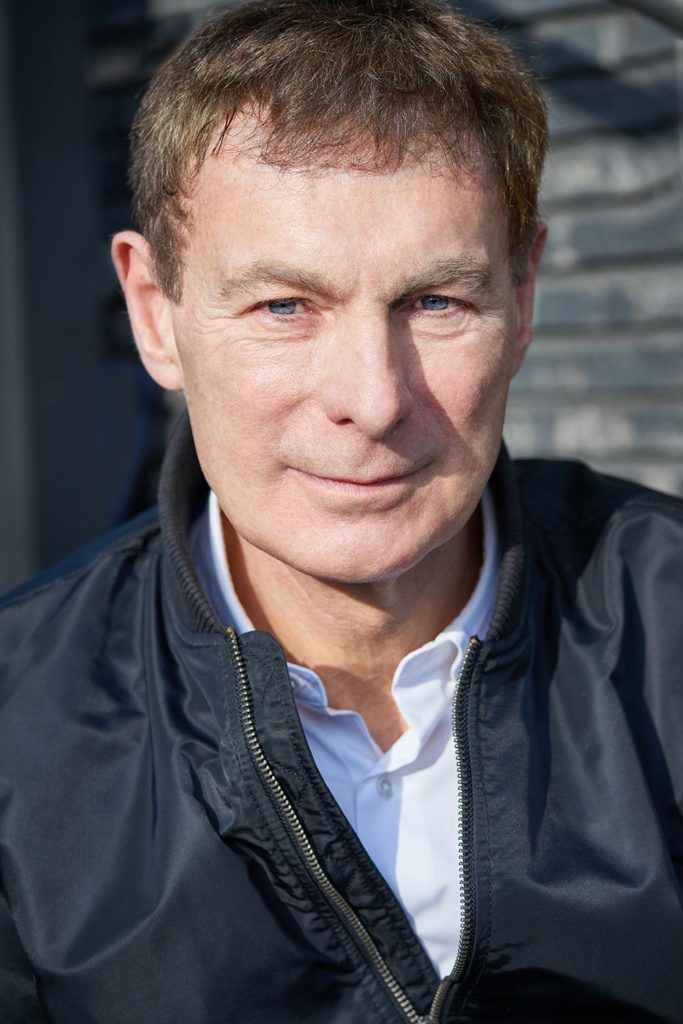
A specialist in China’s media. Hugo de Burgh established the China Media Centre at the University of Westminster in 2005. He has advised many people in UK public life, from Gordon Brown (for whom CMC organised a series of seminars on China in Downing Street) to Boris Johnson whom he accompanied on his first visit to China. His most recent book is China’s Media in the Emerging World Order (2020).
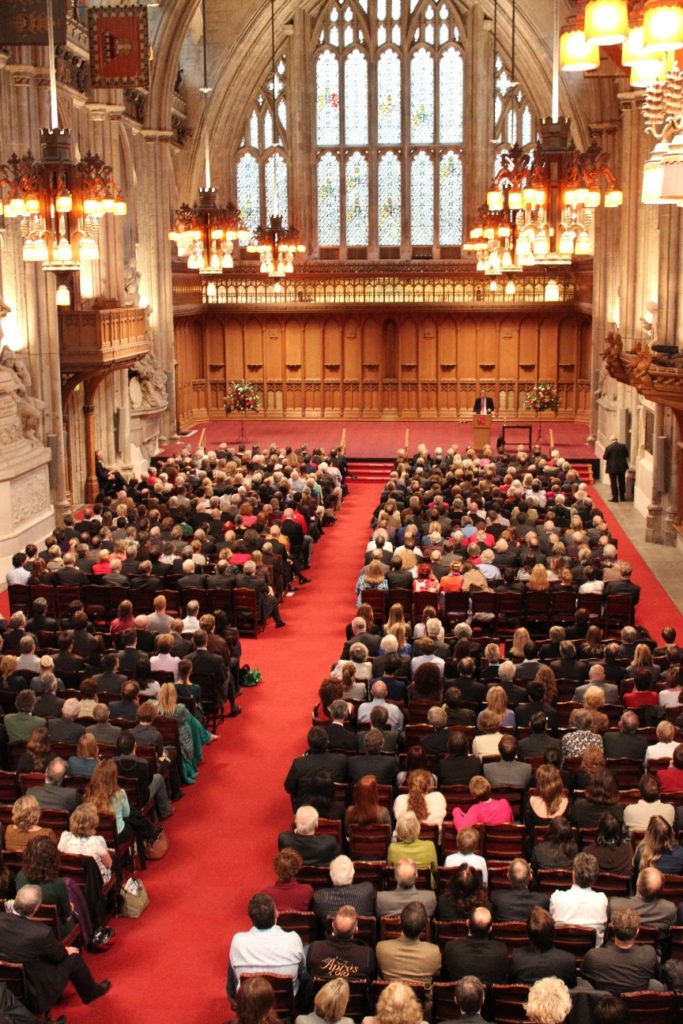
The title of his forthcoming Gresham Lecture is China through its Media.
Bill Bryson delivering a Gresham College lecture.
Gresham College has provided free public lectures since 1597, making it London’s oldest higher education institution. It offers lectures and a number of events in art, architecture, literature, business, history, IT, law, mathematics, science, music and religion. Past lecturers have included Joan Bakewell, Mary Beard, Lord Desai, Helena Kennedy, Alan Rusbridger. Forthcoming lecturers include Yorick Wilks (Artificial Intelligence, Oxford) and Chris Whitty (Chief Scientific Adviser). More information: https://www.gresham.ac.uk/about/
See also: https://www.westminster.ac.uk/news/professor-hugo-de-burgh-awarded-a-gresham-college-lectureship
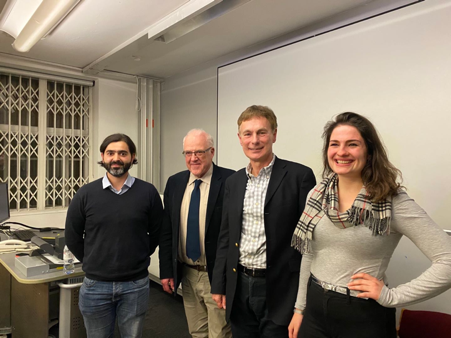
On 28 January 2020 Professor Hugo de Burgh and Professor Iwan Morgan spoke at the UCL European Horizons Society’s discussion of “Who is the biggest threat to the liberal international order: USA, China or Russia?”
In the photograph Professors Iwan Morgan and Hugo de Burgh with the President and Secretary of the UCL European Horizons Society.
The long-standing international rule-based liberal order has come under unprecedented threat in recent years. Threatened not only by Russian interference or undermined by China’s ascendancy to economic dominance but also by American populism in the shape of the current president.
The liberal international order is widely understood as the institutions and rules adopted by nation states belonging to the order to ultimately promote and discount usa cialis super force online defend democracy. But who among these represents the biggest threat to it?
The purpose of the event was to analyse the actions being taken by the USA, China and Russia to undermine key elements of the current order and how this threatens global stability.
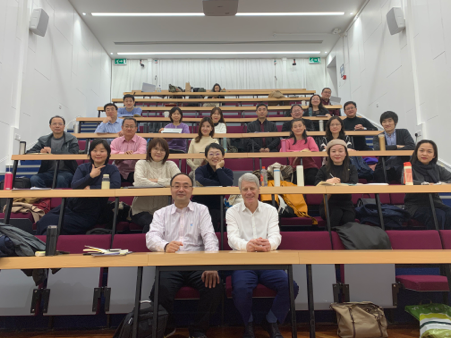
Nick Ross, one of the U.K.’s leading broadcasters, gave a lecture to Chinese media operatives undertaking a course in the China media centre today.
Nick Ross has been one of the most ubiquitous British broadcasters and his best known for hosting the BBC television show Crimewatch for 23 years. He has made many documentaries and major series for both television and radio. He is chairman, president, trustee or patron of a large number of charities.
In his talk to the Chinese broadcasters, who included Yu Jianfeng, Director of the Tianjin Jinyun New Media Group, and Zhang Chenxiao, Deputy Director of the Internet Department of the The National Radio and Television Administration (NRTA), he discussed his experience of reporting in Northern Ireland as having relevance to Chinese media reporting controversial and order viagra soft online price critical situations in China. He talked about the origins of our relatively free media but also of the limitations of that freedom in self censorship and BBC ideology. He said that we need a middle way between the British media’s determination to ferment controversy and the Chinese media’s damping down of controversy. He believes that while China over regulates its media and particularly social media, the UK has been discovering, as it grapples with pornography, poisonous ideologies and terrorism on social media that it has under regulated social media and has now to try to retrofit controls.
China’s National Science Prize awarded to UK graduate on the same day as her father
On Thursday 9 January 2020, China Media Centre PhD and screen producer Dr Zeng Rong received the P.R.C’s National Prize for Science, the highest such award in China.
This is the first time that the National Science Prize has been awarded to someone not a scientist.
The citation for the prize noted that Dr Zeng was the Originator and Executive Producer of two series of the acclaimed TV documentary series The Emergency Room. The award has been made in recognition of her contribution to public understanding of medical science
The Emergency Room is a large-scale medical documentary shot by fixed camera, which was jointly made by Shanghai Media Group and Houghton Street Media. The programme documents the front line of the emergency services, revealing the fragility of life and pas de prescription lasix observes the consultation process of hundreds of patients, with materials shot 24 hours a day and 7 days a week using 78 fixed cameras with a team of over 100 production personnel.
Key members of the production team comprise Westminster media alumnae, including Producer Dr Mi Miao, Production Manager Li Mengyang and Director Wang Tong. Other Westminster alumnae involved in the series include Li Yingying and He Sijia. (all women)
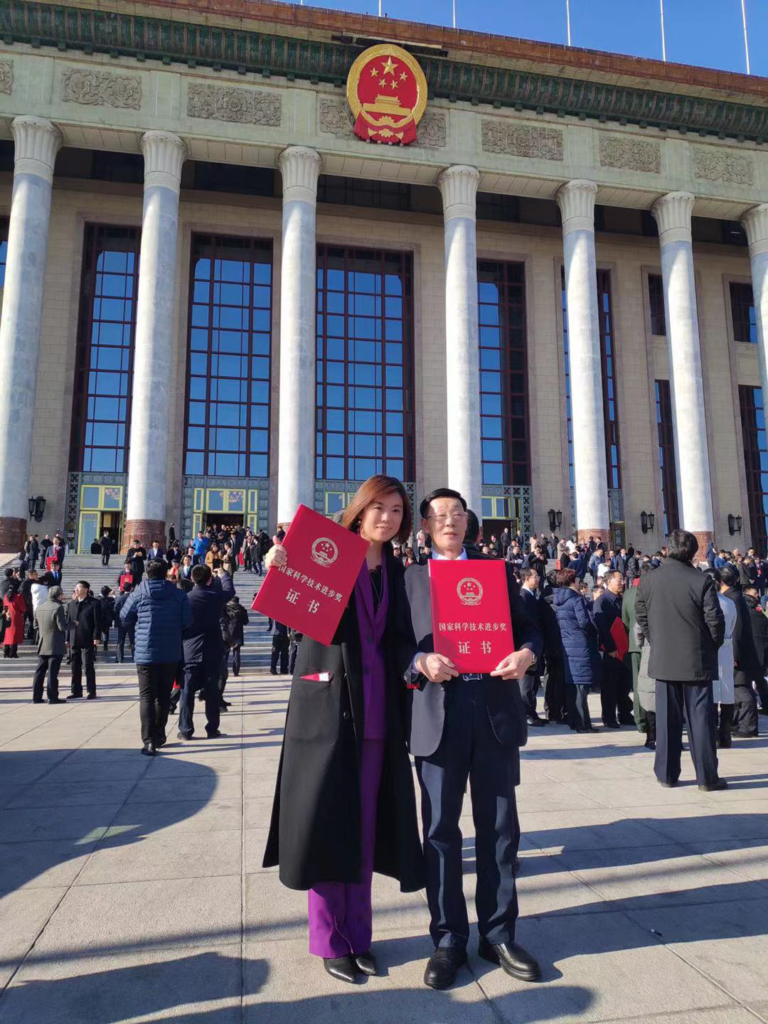
Dr Zeng received the prize at the Great Hall of the People in Beijing whilst in the presence of President Xi Jinping. Her father, cardiologist Dr Zeng Dingyin, received the National Prize for Scientific Research at the same ceremony.
Talking about her achievement, Dr Zeng Rong said: “I am delighted to receive this wonderful award at the Great Hall of the People. The Emergency Room has been one of the most influential television programmes about medical issues and the health services in China and we are very proud of the values and contributions it has made.
The China Media Centre has given me lots of ideas, skills and special vision of transnational culture and the media industry.” I am thrilled that my father was awarded a prize in the same year. We are both very proud and grateful.”
Notes:
ZENG Rong obtained her PhD under the Director of the China Media Centre (CMC), Professor Hugo de Burgh, with a comparison of Chinese and British television news. It was published in 2012 as TELEVISION NEWS AND THE LIMITS OF GLOBALISATION (UBP). She then worked as a Post Doc at the CMC and set up Houghton Street Media (HSM) in 2014 with a fellow alumnus of the LSE, where she had taken the MA Media. Very rapidly, HSM has become one of the most innovative independents in China, producing for many different platforms and often in cooperation with UK creatives and Production companies. It is probably the only independent in China with a Creative Development Team, devising comedies, chat shows and reality TV as well as documentary series. With offices in Shanghai and Beijing, it employs between 100 and 150 full time staff, many of whom studied media in the UK. The top management is entirely female.
The citation for the prize noted that Dr Zeng was Originator and Executive Producer of three series of the acclaimed TV documentary series The Emergency Room. Key persons of the series are Westminster alumnae, especially Li Mengyang (Production Manager) and Wang Tong (Director). Other Westninster alumnae working on the series include Li Yingying and He Sijia.
Making the day unique, Dr Zeng received the prize in the presence of President Xi Jinping at the Great Hall of the People in Beijing on the very same day as her father, cardiologist Professor Zeng Dingyin 曾定尹, received the National Prize for Scientific Research.
Dr Zeng Rong and Professor Zeng Dingyin in front of the Great Hall of the People in Beijing.
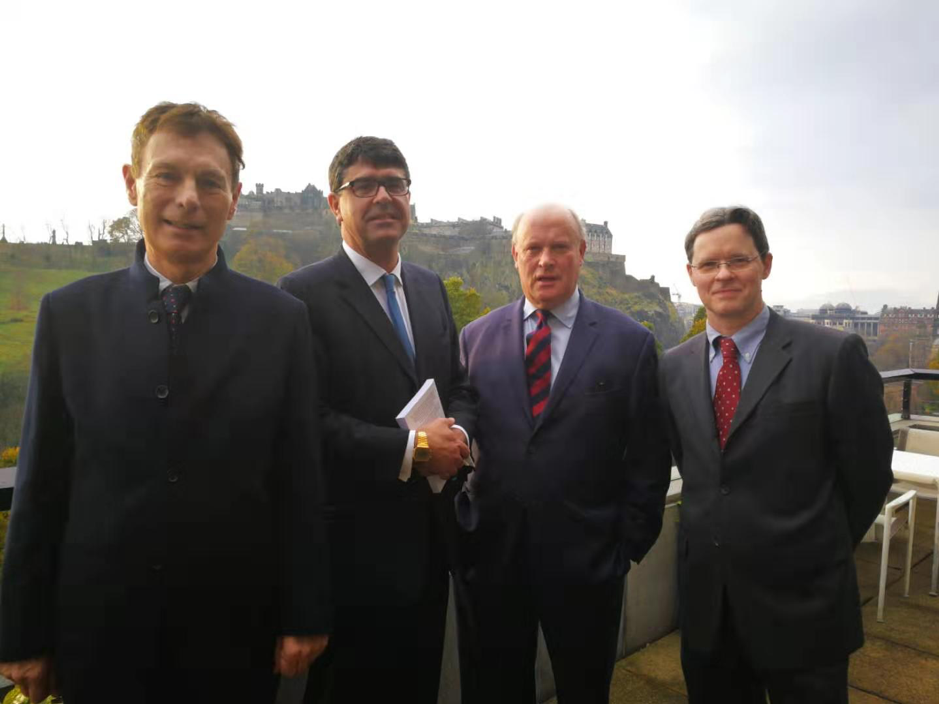
On 19 November 2019 Professor Hugo de Burgh gave a talk to the RSA Scotland in Edinburgh.
In the picture (from left to right): Hugo de Burgh; Adam Keswick, Managing Director of Jardine Matheson; Roddy Gow OBE, The Chairman and Founder of Asia Scotland Institute; Mure Dickie, the Financial Times, formerly based in China as China Correspondent of the Financial Times.
He addressed a number of issues including:
– What China’s media tell us about how Chinese society is developing and introduced several examples, including:
– Weirdo Says (a chat show for millennials in which not only are controversial topics battled over, but where rhetoric and debating skills count)
– Cui Yongyuan’s blog (covering hypocrisy in government pronouncements and using investigative journalism to uncover dealings)
– the fact that China produces more TV drama than any other country – but not about emperors and courtesans, the most popular series being All’s Well! and Good Husbands exposing tensions between family responsibility and modern living.
– The challenges of governance as wonderfully revealed by China’s Trollope, the writer of Civil Service Diary, a sixteen volume novel about the rise from obscurity of a young official.
Hugo de Burgh introduced examples from Internet platforms as well as offline media in discussing what China’s media today tell us about how modern Chinese think and feel.