
China Media Digest 1001 (26Jan-18Feb)
EDITOR: Jackie Fang YIN
Headlines
- Former BBC anchor starts work at CRI
- More publications during 2010 Expo
- Probe traces Google attacks to 2 Chinese schools: report
- China sets limit on Spring Festival SMS
- Common sense, rationality needed for society: CCTV host
-
Jackie Chan launches cinema chain
Former BBC anchor starts work at CRI
FORMER BBC anchor Susan Osman began hosting a breakfast show for China Radio International (CRI) yesterday, Chinese-language media reported yesterday. It was Osman’s first time hosting “The Beijing Hour,†a new current affairs program. Osman signed a one-year contract with the CRI to host the prime-time breakfast show.
Osman, 51, moved to China to escape the ingrained “culture of ageism†in Britain’s broadcasting industry, previous reports said. She has worked in broadcasting for 28 years, presenting bulletins on BBC World and reporting for ITN News before falling out of favor with her bosses, with one even remarking to her, “Are you menopausal?†Of this experience, Osman said: “This is quite typical. I’ve had so many female colleagues who have dropped out in their early 40s, which is a shame because an older woman can bring wisdom and empathy. There don’t seem to be many places for older women in broadcasting in this country [the U.K.].â€â€œIronically, when I started working in television, I was always afraid of not being taken seriously for being young. The truth is when you’re not getting any younger, it becomes even worse,†she added.
In response to Osman’s comments, a BBC spokesman said: “Broadcasting, especially presenting, is an extremely competitive industry and the nature of it is such that many broadcasters are freelance artists on contracts of specific durations. Ageism has nothing to do with it.â€
Osman’s son, who graduated from Oxford, came to China last year and advised his mother to make the move. “In China they revere experience,†she said. “The older you are the better. I got the impression that my future boss actually wanted me to be older when I finally told him my age during the interview. He hopes I could help in training young reporters.†( Shenzhen Daily 2010-1-26 )
More publications during 2010 Expo
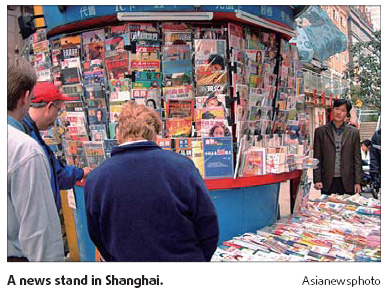
German newspapers like Bild and racy Italian magazines may be available in Shanghai this summer as Expo organizers consider lifting the curbs on foreign publications during the six-month-long cultural gala. Scores of the 192 countries that will join the Expo have already given their tacit backing to the lifting of the ban as they aim to promote their respective pavilions or culture through their national media, which they would like to see on sale in the host city.
Their response came after Zhu Yonglei, deputy director-general with the Bureau of Shanghai World Expo Coordination, said last month that proposals would be sent out soon to gauge the level of interest from participating countries and Expo tourists. “We would appreciate it very much if all materials related to the activity of the Italian pavilion could be available to Chinese, international and Italian visitors in Shanghai,” the country’s Expo team told China Daily. “We are confident that the Expo bureau will identify the appropriate solution.”
A similar easing of restrictions took place in Beijing during the 2008 Olympics, when 100 overseas publications hit news kiosks located in areas catering to athletes and international media covering the Games in the Chinese capital.
Germany, which hosted the 2000 Hanover Expo, is looking to import its newspapers after seeing the positive response to hand out free copies of the FAZ (Frankfurt General Newspaper) during the 2005 Aichi Expo in Japan. Dietmar Schmitz, Germany’s commissioner general to the 2010 Expo, said he hopes to do the same this year. “Germany is very much satisfied with the preparatory work for Expo 2010 and we look back on a very fruitful cooperation with our partners from the Expo bureau,” he said. “I am very much confident that in this matter the Expo organizers will also find a satisfying solution.” ( China Daily 08-02-2010 )
Probe traces Google attacks to 2 Chinese schools: report
NEW YORK (Reuters) – Recent cyber attacks on Google and other American corporations have been traced to a top Chinese university as well as a school with ties to the Chinese military, the New York Times reported on Thursday, citing people involved in the investigation. Those people told the Times that the Chinese schools involved are Shanghai Jiaotong University and the Lanxiang Vocational School. They said the attacks may have started as early as April 2009 — earlier than previously thought.
According to the report, investigators believe there is evidence suggesting a link to a computer science class at the vocational school taught by a Ukrainian professor. Google jolted U.S.-China ties with its January 12 announcement that it had faced a “highly sophisticated and targeted attack” in mid-December, allegedly from inside China. More than 20 other companies were also targeted, though Google said a primary target was dissidents’ email accounts. Jill Hazelbaker, Google’s director of corporate communications said that the company’s investigation is ongoing, but otherwise declined to comment. The Chinese schools were not immediately available for comment, but the Times said they had not heard that American investigators had traced the Google attacks to their campuses. (Reuters.com 18-02-2010)
China sets limit on Spring Festival SMS
Mobile users restricted to 500 messages an hour in crackdown. Mobile phone users in China will need to limit the number of Chinese New Year text messages they send during Spring Festival as part of a crackdown on spam messages.
An agreement among the country’s three main mobile network operators last June stipulates that if the number of messages sent from a phone number reaches 200 within an hour or 1,000 within a day, the phone’s message service will be suspended for a week.For holidays and weekends, the allowable limit will increase to 500 hourly and 2,000 every day, it said. Wei Leping, chief-engineer from China Telecom told China Daily yesterday that even during Spring Festival, the crackdown on spam messages will continue. “Even though such strict measures to fight against junk messages are taken, many people still receive tens of such messages,” Wei said.
Mobile phone subscribers received about 10 spam messages every week by the end of 2008, which means more than 300 million unwanted messages were delivered that year, according to statistics from the Ministry of Industry and Information Technology. The most common type of spam includes promotions for real estate, retail, traffic and tourism industries.
Considering the harm of spam messages, some phone users support the limitation on message numbers. Sun Qian, a postgraduate at Liaoning Normal University, said it was a good service.” A normal person rarely sends more than 100 messages within an hour even during holidays, unless he or she is a spammer or a cheater,” Sun said.
Official figures show Chinese mobile phone users sent 18 billion text messages during last year’s 7-day Spring Festival holiday, and the figure is expected to increase this year. Wei said operators did not have the right to read short messages and decide which was junk and which was not. There were about 700 million mobile users on the Chinese mainland as of July last year.( China Daily 01-02-2010 )
Common sense, rationality needed for society: CCTV host
Chinese society needs to show respect to common sense, think rationally in government administration, including pursuing its democracy model, and search for beliefs amidst the rapid economic growth, said Bai Yansong, China’s leading television host, in an interview with the Beijing News.
In a commentary published on Saturday Feb. 2, the acclaimed anchorman said that there was a time when Chinese people’s common sense was distorted by politics or manipulated by some people’s interests. Bai criticized that during the Cultural Revolution people exaggerated that millions of kilograms of grains were produced on a very small piece of farmland in a single year, with many people believing the ridiculous numbers.
Even today people’s common sense may be still affected by unethical media reports due to economic interests. A so-called medical expert preached his “healthy diet”, implying that many types of traditional foods that Chinese people have lived on for thousands of years were harmful. No media stood out to question him and finally it turned out that he was misleading the public and distorting people’s common senses to benefit himself. Although the expert was eventually sentenced for his crime, the case made people worry that economic interests were challenging people’s common senses, Bai said.
To construct rational thinking is also important for the Chinese government as well as the whole society. The Communist Party of China has changed from a revolutionary party into a governing party, assuming the role of serving the whole society that includes people it likes and hates, which requires the party to act very rationally, Bai said.
Rationality, Bai said, should also be an important characteristic of people living in this large country.
He said a lot of things were sensitive in the past and people were confused about what to say and what not to say. Last year CCTV broadcast Premier Wen Jiabao being attacked by shoes when giving a lecture, which was considered a very sensitive thing but nothing happened, he said.
The power of sensitivity is strong and will grow even stronger when you think it is sensitive, but when you treat it brightly or even ignore it, it will just die out, according to Bai.
In regard with the government’s role in constructing rationality, Bai said the government’s rationality depends on the shift of governing the country by people to governing it by law.(chinadaily.com.cn 08-02-2010)
Jackie Chan launches cinema chain
International movie star Jackie Chan has taken on another role in the film industry: boss of a movie theater chain.
The first Jackie Chan – Yaolai International Cinema, co-funded by the kung fu star and Hong Kong-based Sparkle Roll Group Limited, started trial operations in west Beijing on Monday with a private screening of Chan’s new comedy “Little Big Soldiers.” With 17 screens and 3,500 seats, the venue covers 15,000 square meters and claims to be the largest movie theatre in the country.
Five halls in the cinema provide free hearing-aid equipment for those in need, Jackie Chan said.
The actor said he hopes the venue will also offer screens for non-commercial films and productions by young directors. Fifteen Jackie Chan cinemas are expected to open in Beijing, Shanghai and Guangzhou this year. ( CRIENGLISH.com 09-02-2010 )
Related Images: